AI Infrastructure Is Quietly Hitting Its First Hard Limits
Introduction
Enterprise AI infrastructure has reached an inflection point. Organizations deploying large-scale AI workloads are encountering fundamental physical and architectural constraints that cannot be solved by simply adding more hardware. These AI infrastructure limits span power consumption, cooling capacity, network bandwidth, and memory architecture—forcing a recalibration of how enterprises approach AI compute scaling.
The constraints are not theoretical. Major cloud providers are delaying data center deployments due to power grid limitations. GPU clusters are thermal throttling despite sophisticated cooling systems. Memory bandwidth has become the primary bottleneck for inference workloads, not compute power. These AI compute bottlenecks signal that the industry's rapid scaling phase is transitioning into an optimization and efficiency phase, with significant implications for enterprise AI strategies.
Background
AI infrastructure scaling followed a predictable trajectory through 2023: more GPUs, larger clusters, and higher power consumption. Training GPT-3 required approximately 1,287 MWh of energy. Training GPT-4 consumed an estimated 50,000 MWh. This exponential growth in compute demand coincided with the deployment of massive GPU clusters, with some facilities housing 25,000+ H100 GPUs in single locations.
The infrastructure supporting these workloads evolved rapidly. Data centers designed for traditional enterprise workloads typically operate at 5-10 kW per rack. AI-focused facilities now require 40-80 kW per rack, with some experimental deployments reaching 120 kW per rack. Cooling systems shifted from air-based to liquid cooling, and power distribution architectures required complete redesigns to handle the electrical load.
Network infrastructure scaled alongside compute requirements. High-bandwidth interconnects like InfiniBand and Ethernet fabrics became standard for GPU cluster scaling, with aggregate bandwidth requirements reaching multiple terabits per second for large training runs. Memory hierarchies expanded to include high-bandwidth memory (HBM), distributed memory pools, and specialized caching layers to feed data to increasingly hungry accelerators.
This scaling approach worked until physical limits began asserting themselves across multiple dimensions simultaneously.
Key Findings
Power Grid Integration Constraints
Data center power constraints have emerged as the most immediate limitation. Power grid capacity, not hardware availability, now determines deployment timelines for major AI infrastructure projects. Northern Virginia, home to approximately 70% of global internet traffic and a concentration of hyperscale data centers, has implemented informal moratoriums on new high-power facility connections.
The constraint is not just total power availability but power quality and distribution. AI workloads create unique electrical demands with high power density, rapid load changes during training iterations, and harmonic distortion that affects grid stability. Utilities require 18-36 months lead time for major grid upgrades, creating a bottleneck that cannot be solved with capital expenditure alone.
Google has publicly acknowledged that some AI projects are being delayed due to power availability rather than hardware constraints. Microsoft has explored small modular nuclear reactors specifically for AI data center applications. Amazon Web Services has announced $35 billion in Virginia data center investments, but the rollout timeline is constrained by electrical infrastructure, not construction capacity.
Thermal Density Breaking Points
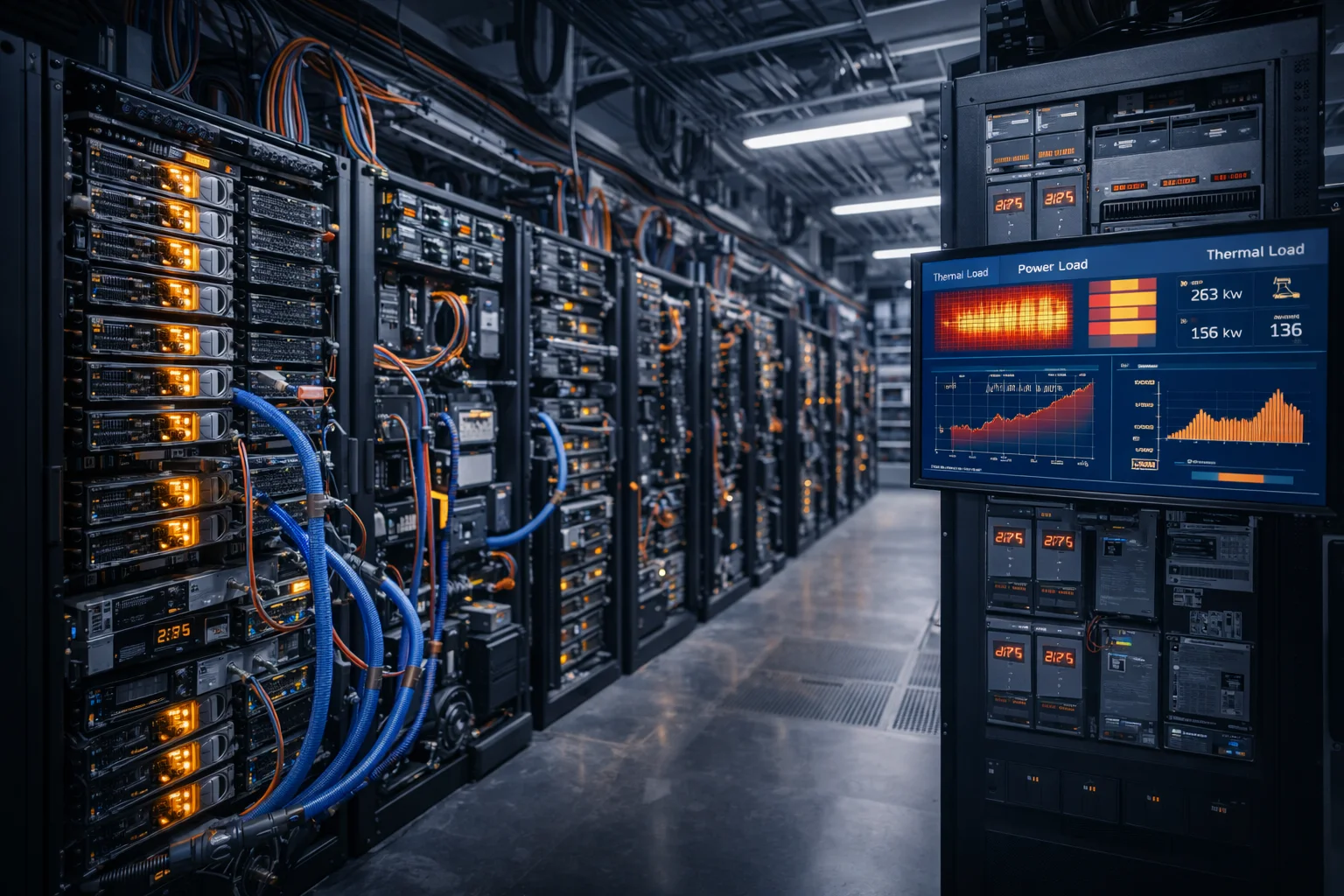
AI cooling challenges have reached physical limits in air-cooled environments. Traditional data center cooling assumes hot aisle/cold aisle configurations with 20-25°C temperature differentials. AI accelerators generate heat densities of 700+ watts per GPU, creating thermal challenges that exceed the heat transfer capabilities of air at reasonable flow rates.
Liquid cooling adoption has accelerated, but brings operational complexity. Direct-to-chip liquid cooling requires new maintenance procedures, leak detection systems, and fluid management capabilities that most enterprise IT teams lack. Immersion cooling, while thermally effective, introduces challenges around component accessibility and upgrade cycles.
The thermal constraint affects more than just cooling systems. High operating temperatures reduce semiconductor reliability and performance. GPU boost clocks automatically throttle under thermal stress, reducing effective compute performance. Memory subsystems are particularly sensitive to temperature, with error rates increasing exponentially above optimal operating ranges.
Data centers designed for AI workloads now allocate 30-40% of facility power for cooling, compared to 15-20% for traditional data centers. This overhead directly impacts computational efficiency and operational costs.
Memory Bandwidth Saturation
Memory architecture has become the primary performance bottleneck for AI inference workloads, particularly for large language models. Modern GPUs provide enormous computational throughput—the H100 delivers 1,979 TOPS for INT8 operations—but memory bandwidth has not scaled proportionally.
The constraint manifests during inference operations where models must load parameters from memory for each token generated. For a 175-billion parameter model, generating a single token requires moving approximately 350 GB of data from memory to compute units, assuming 16-bit precision. Memory bandwidth of 3.35 TB/s, available on current high-end GPUs, limits token generation rates regardless of computational capacity.
This bandwidth limitation drives model optimization techniques like quantization, pruning, and knowledge distillation. However, these approaches involve accuracy tradeoffs. Enterprises deploying production AI systems must balance model performance against infrastructure constraints—a engineering decision that affects system capability.
Distributed inference across multiple GPUs introduces network latency that compounds the memory bandwidth problem. Model sharding and tensor parallelism help distribute the memory load but increase communication overhead and system complexity.
Network Fabric Scaling Limits
HPC infrastructure interconnects face bandwidth and latency constraints as cluster sizes increase. Training large models requires all-to-all communication patterns where each GPU must exchange data with every other GPU in the cluster. Communication overhead scales quadratically with cluster size, creating efficiency barriers for large deployments.
InfiniBand networks, standard for HPC applications, provide 400 Gb/s per port with sub-microsecond latency. However, large GPU clusters require thousands of interconnected nodes, creating network topologies where communication patterns determine training efficiency. Fat-tree and dragonfly topologies help manage bandwidth allocation, but network congestion during all-reduce operations limits effective scaling.
Ethernet-based alternatives offer cost advantages but introduce latency penalties. RDMA over Converged Ethernet (RoCE) provides near-InfiniBand performance at lower cost but requires specialized network configuration and management. The choice between network fabrics involves tradeoffs between cost, performance, and operational complexity that affect long-term infrastructure scaling.
Network-attached memory and disaggregated architectures represent attempts to address scaling constraints by separating compute and memory resources. These approaches reduce per-node memory requirements but introduce network latency into the memory access path, creating new performance bottlenecks.
Implications
These infrastructure constraints force fundamental changes in enterprise AI strategies. The era of scaling through hardware addition is transitioning to optimization-focused approaches that maximize efficiency within physical limits.
Enterprises must now factor infrastructure constraints into AI project planning. Model selection involves evaluating memory bandwidth requirements, power consumption, and cooling capacity alongside computational needs. Training approaches shift toward techniques that reduce infrastructure demands: gradient checkpointing to reduce memory usage, mixed-precision training to lower bandwidth requirements, and distributed training strategies that minimize communication overhead.
Investment priorities are shifting from raw compute power toward infrastructure efficiency. Liquid cooling systems, advanced power management, and high-efficiency network fabrics become competitive advantages rather than optional upgrades. Organizations that optimize for infrastructure efficiency can deploy larger models or serve more concurrent users within the same physical constraints.
The constraints also affect competitive dynamics among cloud providers. Raw GPU availability becomes less differentiated as efficient utilization becomes the key differentiator. Providers that solve cooling, power, and network scaling challenges can offer better price-performance ratios for AI workloads.
Geographic distribution of AI infrastructure becomes more strategic. Locations with abundant power, favorable cooling climates, and robust network connectivity provide operational advantages. The concentration of AI compute in specific regions creates supply chain vulnerabilities and regulatory risks that enterprises must consider.
Considerations
Several factors complicate the analysis of AI infrastructure limits. Technology improvements continue to address specific constraints—more efficient semiconductors, advanced cooling techniques, and optimized algorithms—but physical limits remain fundamental constraints.
The timeline for infrastructure improvements varies significantly. Power grid upgrades require years of planning and regulatory approval. Cooling system retrofits can be implemented in months. Network fabric upgrades fall somewhere between, depending on existing infrastructure and compatibility requirements.
Cost implications of addressing these constraints are substantial but unevenly distributed. Liquid cooling systems require 2-3x the capital expenditure of air cooling but provide higher compute density. The total cost of ownership calculation depends on utilization rates, power costs, and operational efficiency gains.
Regulatory factors add complexity to infrastructure planning. Environmental regulations affect cooling system design and power consumption. Grid interconnection standards vary by jurisdiction. Data sovereignty requirements may force inefficient geographic distribution of AI infrastructure.
Technology evolution may shift constraint priorities. Advances in model compression could reduce memory bandwidth requirements. New cooling technologies might address thermal density limits. However, these improvements typically require 3-5 years to reach production deployment, creating a planning horizon where current constraints must be addressed.
Key Takeaways
• Power availability, not hardware cost, now determines AI infrastructure deployment timelines, with utilities requiring 18-36 months for major grid upgrades to support high-density AI facilities.
• Memory bandwidth has emerged as the primary bottleneck for AI inference workloads, limiting token generation rates regardless of computational capacity and driving model optimization techniques with accuracy tradeoffs.
• Thermal density constraints force liquid cooling adoption in AI-focused data centers, increasing capital expenditure by 2-3x but becoming necessary for GPU cluster scaling beyond traditional air-cooling limits.
• Network fabric scaling limits create quadratic communication overhead in large GPU clusters, making distributed training efficiency dependent on interconnect topology and bandwidth allocation strategies.
• Geographic concentration of AI infrastructure creates supply chain and regulatory vulnerabilities, driving strategic distribution of compute resources to locations with power, cooling, and connectivity advantages.
• Infrastructure efficiency optimization becomes a competitive differentiator as raw compute availability becomes commoditized and organizations compete on effective utilization within physical constraints.
• Enterprise AI strategies must integrate infrastructure constraints into project planning, evaluating model selection, training approaches, and deployment architectures based on power, cooling, memory, and network limitations rather than purely computational requirements.