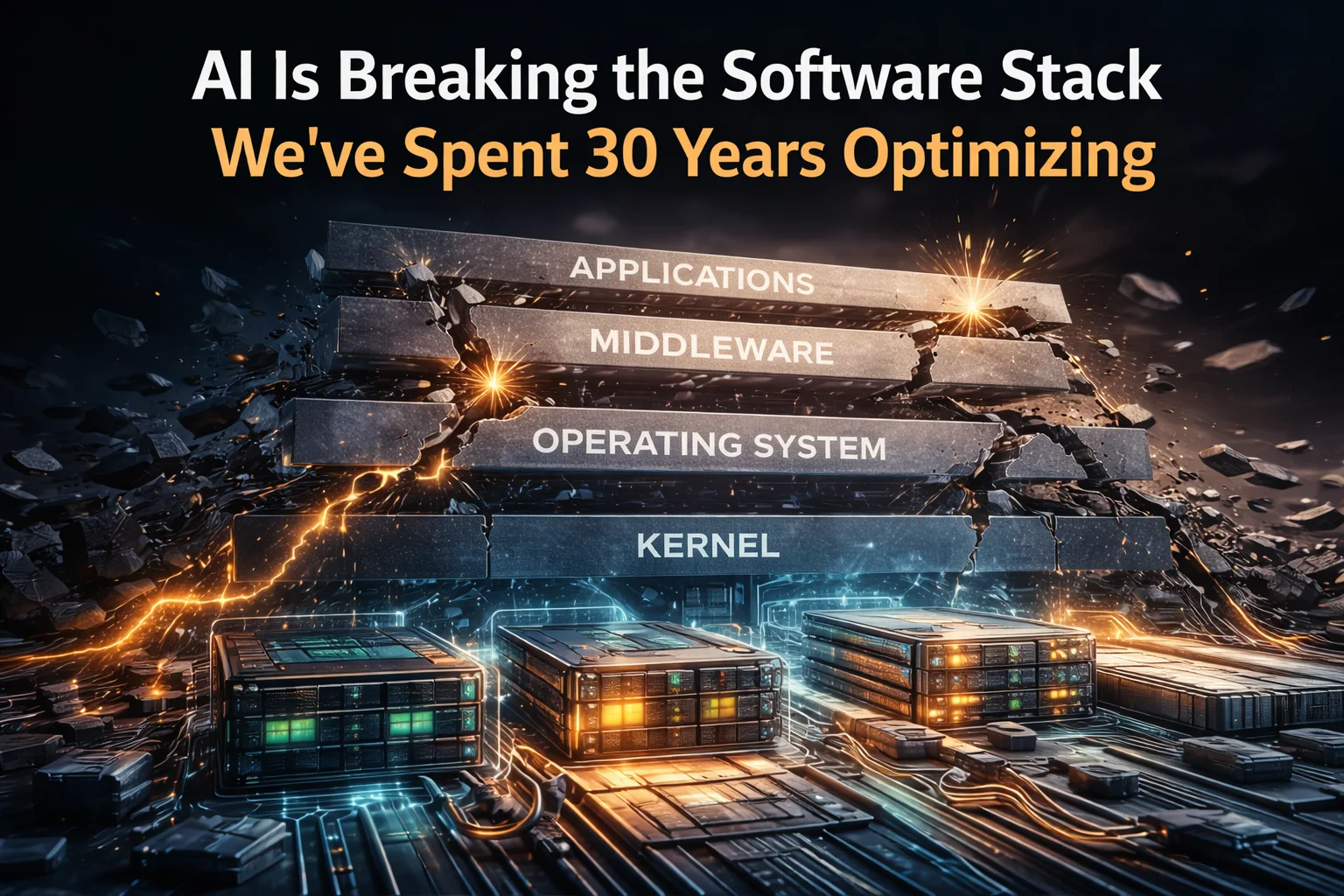
AI Is Breaking the Software Stack We've Spent 30 Years Optimizing
Introduction
The software stack that powers modern enterprises—from web servers to databases to application frameworks—was designed for a fundamentally different computational model than what artificial intelligence demands. Built around stateless request-response patterns, CPU-centric processing, and predictable resource consumption, this architecture served the industry well through the era of web applications and distributed systems. However, AI workloads require sustained computation, massive parallel processing, and dynamic memory allocation patterns that expose fundamental limitations in how we've structured software systems.
This mismatch isn't merely an inconvenience requiring minor adjustments. AI applications are forcing a complete rethinking of software architecture, from the hardware abstraction layer to application deployment patterns. Companies running large-scale AI systems are discovering that their existing infrastructure optimization strategies—load balancing, caching, horizontal scaling—often work against AI performance requirements rather than enhancing them.
Background
The traditional software stack evolved through distinct optimization phases. The 1990s focused on single-server performance and database optimization. The 2000s brought distributed computing and service-oriented architectures. The 2010s emphasized containerization, microservices, and cloud-native patterns. Each evolution maintained backward compatibility while adding new layers of abstraction.
This architecture assumes computation follows predictable patterns: requests arrive, get processed quickly, and release resources. Web servers handle thousands of lightweight connections. Databases optimize for transactional consistency. Application frameworks prioritize developer productivity and horizontal scaling. Memory management focuses on garbage collection efficiency rather than sustained high-throughput operations.
Modern AI workloads violate virtually every assumption underlying this design. Machine learning inference can require seconds or minutes of sustained computation per request. Training workloads consume GPU resources for hours or days continuously. Model weights occupy gigabytes of memory that must remain accessible throughout processing. Data preprocessing involves streaming large datasets through complex transformation pipelines that don't fit traditional batch or real-time processing patterns.
The semiconductor industry has recognized this shift. NVIDIA's data center revenue grew from $1.9 billion in 2020 to $47.5 billion in 2024, driven primarily by AI compute demand. However, software infrastructure has been slower to adapt, creating a growing disconnect between hardware capabilities and software utilization efficiency.
Key Findings
Memory Architecture Incompatibility
Traditional applications optimize for memory efficiency through techniques like just-in-time loading, memory pooling, and garbage collection. AI workloads require the opposite approach: pre-loading large models into memory and maintaining them for extended periods. A typical transformer model like GPT-3 requires 175 billion parameters, consuming roughly 350GB of memory when loaded in full precision. Existing memory management systems, designed around smaller objects with shorter lifecycles, perform poorly under these conditions.
Companies like Anthropic and OpenAI have had to develop custom memory management systems that bypass traditional runtime garbage collection entirely. These systems pre-allocate large contiguous memory blocks and manage model weights manually, essentially rebuilding core operating system functionality at the application layer.
CPU-GPU Coordination Failures
The software stack assumes CPU-centric processing with occasional acceleration from specialized hardware. AI workloads invert this relationship, requiring GPUs to perform the majority of computation while CPUs handle data preparation and coordination. This creates bottlenecks in data transfer between CPU and GPU memory spaces, particularly when using frameworks designed around CPU-first architectures.
Meta's PyTorch framework has evolved to address some coordination issues through techniques like CUDA streams and asynchronous memory transfers, but fundamental limitations remain. Traditional web application servers like Apache or Nginx cannot effectively coordinate GPU resources across multiple concurrent AI requests, leading companies to develop specialized serving infrastructure like NVIDIA's Triton Inference Server or custom solutions.
Networking and Load Distribution Challenges
Standard load balancing algorithms distribute requests based on CPU utilization or simple round-robin patterns. AI workloads require awareness of model loading state, GPU memory availability, and batch processing opportunities. A server that appears idle from a CPU perspective might be running inference on a large batch, making it unsuitable for additional requests.
Google's Kubernetes team has introduced GPU-aware scheduling and custom resource definitions specifically to address these limitations. However, most existing container orchestration and load balancing infrastructure requires significant modification to handle AI workloads effectively.
Storage and Data Pipeline Misalignment
Traditional storage optimization focuses on transactional integrity and concurrent access patterns typical of database workloads. AI training and inference require sustained sequential reads of large datasets, often with complex preprocessing requirements that don't map well to existing caching strategies.
Companies like Databricks have built specialized data platforms that optimize for machine learning pipelines, including features like Delta Lake for versioned datasets and MLflow for experiment tracking. These platforms essentially replace traditional ETL infrastructure with AI-specific alternatives.
Scaling Pattern Disruption
Horizontal scaling—adding more servers to handle increased load—works well for stateless web applications but creates complexity for AI workloads. Model weights must be distributed across multiple GPUs, requiring coordination between nodes that traditional load balancing cannot handle effectively. Vertical scaling—adding more powerful hardware to existing servers—becomes more important, contrary to cloud-native best practices.
OpenAI's GPT-4 training required coordination across thousands of GPUs, necessitating custom networking and synchronization protocols that operate outside traditional distributed systems frameworks. The result is infrastructure that looks more like high-performance computing clusters than typical cloud deployments.
Implications
Infrastructure Investment Patterns
Enterprises are discovering that AI adoption requires fundamental infrastructure changes rather than incremental upgrades. Companies cannot simply add AI capabilities to existing systems; they must build parallel infrastructure optimized for AI workloads. This doubles infrastructure complexity and operational overhead during transition periods.
Financial services firms implementing AI for fraud detection report needing separate GPU clusters, specialized data pipelines, and custom monitoring systems alongside their existing transaction processing infrastructure. The operational complexity of maintaining two distinct architectural patterns creates significant engineering overhead.
Skills and Operational Gaps
Traditional DevOps practices and monitoring tools provide limited visibility into AI workload performance. GPU utilization patterns differ significantly from CPU metrics. Model performance degrades in ways that don't correlate with traditional application health indicators. Training job failures often require domain expertise in machine learning rather than general systems administration knowledge.
Organizations are finding they need teams with hybrid skills spanning traditional infrastructure management and machine learning operations (MLOps). This skillset combination is rare and expensive, creating hiring bottlenecks for AI adoption.
Vendor and Technology Lock-in
The specialized nature of AI infrastructure creates stronger vendor dependencies than traditional software stacks. NVIDIA's CUDA ecosystem provides the most mature development tools for GPU programming, but limits hardware flexibility. Cloud providers offer managed AI services that simplify deployment but reduce portability between platforms.
Companies building AI systems must choose between maintaining infrastructure flexibility and leveraging optimized AI-specific platforms. This trade-off is more severe than typical technology decisions because AI workload requirements differ so significantly from general-purpose computing.
Cost Model Disruption
Traditional cloud economics assume that resource utilization can be optimized through statistical multiplexing—many small workloads sharing resources efficiently. AI workloads consume large amounts of resources for extended periods, reducing the effectiveness of resource sharing and increasing infrastructure costs per unit of work accomplished.
Training large language models can cost millions of dollars in compute resources, while inference serving requires maintaining expensive GPU resources that may be idle between requests. These cost patterns don't align well with existing cloud pricing models or enterprise budgeting processes.
Considerations
Transition Timeline and Compatibility
Organizations cannot abandon their existing software stack immediately to adopt AI-optimized infrastructure. Most enterprises will need to operate hybrid environments for several years, supporting both traditional applications and AI workloads. This creates complexity in resource allocation, monitoring, and operational procedures that must be factored into AI adoption planning.
The pace of AI infrastructure evolution also means that investments made today may become obsolete quickly. Hardware architectures are changing rapidly, with new GPU designs, specialized AI chips, and networking technologies emerging regularly. Software frameworks are similarly volatile, with new versions introducing breaking changes more frequently than traditional enterprise software.
Scale and Applicability Thresholds
Not all AI workloads require infrastructure changes of the same magnitude. Simple machine learning models for data analysis or lightweight natural language processing may integrate reasonably well with existing systems. The infrastructure challenges become severe primarily for large-scale generative AI, computer vision, or complex training workloads.
Organizations should evaluate their specific AI requirements carefully rather than assuming all AI adoption requires complete infrastructure overhaul. However, the trend toward larger, more capable models suggests that infrastructure requirements will likely increase over time.
Regulatory and Compliance Implications
AI systems often handle sensitive data and make decisions with regulatory implications, particularly in healthcare, finance, and government applications. The specialized infrastructure required for AI workloads may not inherit the compliance certifications and audit trails that traditional enterprise software provides.
Organizations in regulated industries must ensure that their AI infrastructure meets data protection, auditability, and security requirements that may be more difficult to implement on GPU-centric, custom infrastructure than on traditional database and application server platforms.
Key Takeaways
• Traditional software stacks optimize for request-response patterns and CPU-centric processing, while AI workloads require sustained computation and GPU coordination that existing architectures handle poorly
• Memory management systems designed around small, short-lived objects cannot efficiently handle the multi-gigabyte model weights that AI applications require to keep loaded continuously
• Load balancing and horizontal scaling strategies that work well for stateless web applications create complexity and inefficiency for AI workloads that benefit more from vertical scaling and specialized resource allocation
• Organizations implementing AI systems must build parallel infrastructure rather than extending existing systems, doubling operational complexity during transition periods
• The specialized nature of AI infrastructure creates stronger vendor lock-in and higher operational skill requirements compared to traditional software stacks
• Cost models based on resource sharing and statistical multiplexing become less effective with AI workloads that consume large amounts of resources continuously
• Hybrid environments supporting both traditional applications and AI workloads will be necessary for most enterprises, requiring careful planning for resource allocation and operational procedures across different architectural patterns