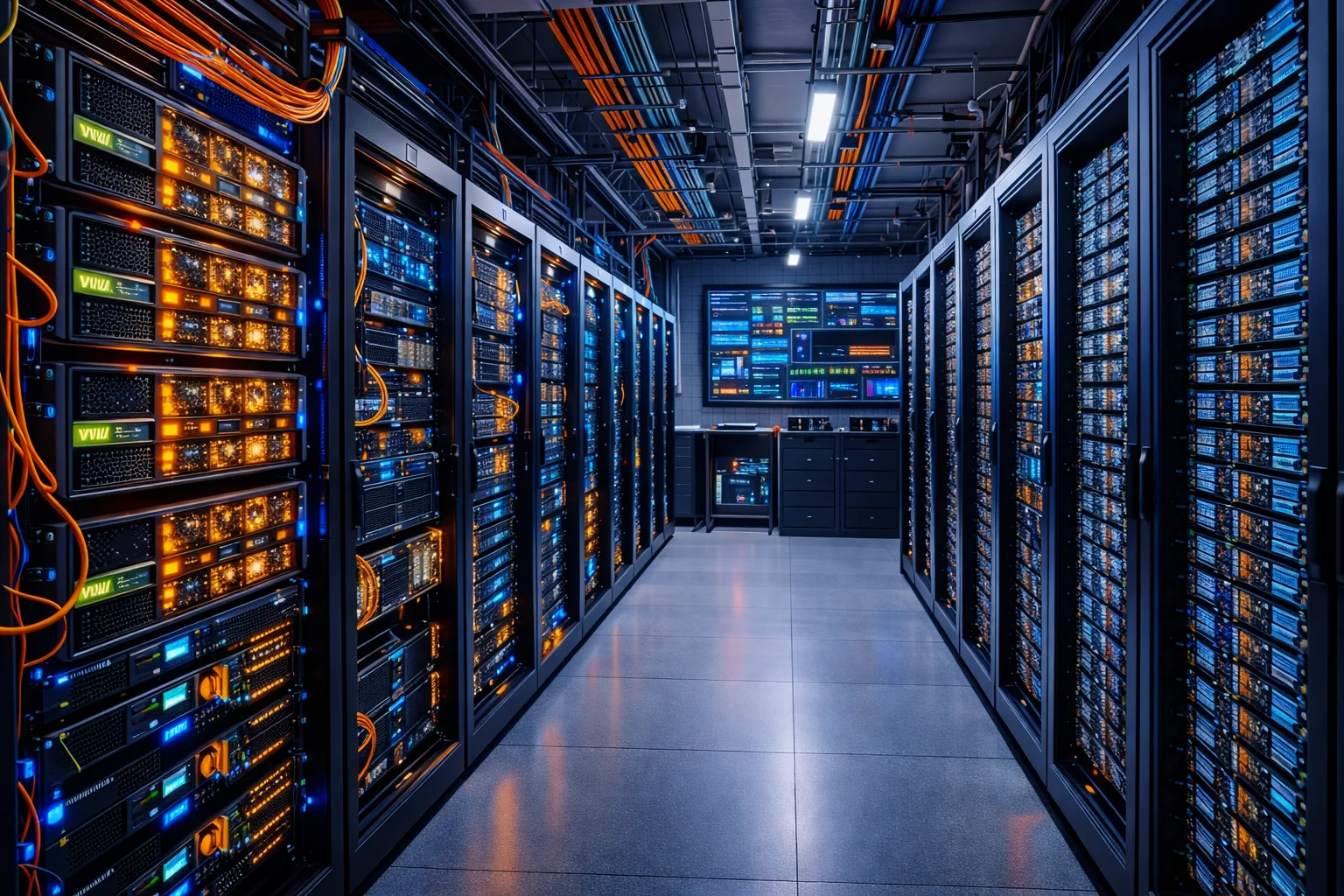
How Modern HPC Clusters Are Being Designed for Mixed AI and Simulation Workloads
Introduction
High-performance computing infrastructure has reached an inflection point. Traditional HPC clusters, designed primarily for physics simulations, computational fluid dynamics, and mathematical modeling, now must accommodate machine learning training, AI inference, and hybrid workflows that combine both paradigms. This convergence creates fundamental architectural challenges that organizations like Lawrence Livermore National Laboratory, NVIDIA's DGX systems, and cloud providers are addressing through heterogeneous HPC systems that can efficiently handle both traditional simulation workloads and modern AI workloads.
The stakes are significant. Organizations investing millions in HPC infrastructure need systems that maximize utilization across diverse computational demands rather than maintaining separate clusters for different workload types. Modern HPC cluster design now centers on creating mixed workload HPC clusters that can dynamically allocate resources, manage thermal constraints, and optimize data movement patterns for fundamentally different computational approaches.
Background
Traditional HPC clusters were optimized for tightly coupled, communication-intensive workloads. Scientific simulations typically involve iterative numerical methods where nodes must frequently exchange boundary conditions or intermediate results. This drove architectures with high-bandwidth, low-latency interconnects like InfiniBand, CPU-centric compute nodes, and parallel file systems designed for sustained throughput rather than random access patterns.
AI workloads present different computational characteristics. Deep learning training involves massive matrix operations that benefit from GPU acceleration, but with communication patterns focused on parameter synchronization rather than continuous boundary exchanges. Inference workloads often require lower latency and higher throughput for smaller computational tasks. The memory access patterns, power consumption profiles, and scaling characteristics differ substantially from traditional HPC applications.
The convergence accelerated when simulation scientists began incorporating machine learning into their workflows. Climate modeling teams at institutions like NCAR started using neural networks for parameterization of sub-grid processes. Computational chemistry researchers began replacing expensive quantum calculations with ML-trained surrogate models. These hybrid approaches require infrastructure that can seamlessly transition between simulation phases and AI acceleration phases within the same job.
Modern mixed workload environments also reflect economic realities. A dedicated AI cluster might achieve 60-80% utilization during training campaigns but remain idle between projects. Traditional HPC clusters often see utilization patterns tied to grant cycles or project deadlines. Combining these workloads allows organizations to achieve higher overall utilization rates and better return on infrastructure investments.
Key Findings
Heterogeneous Node Architecture Becomes Standard
Modern HPC cluster design increasingly adopts heterogeneous node configurations rather than homogeneous compute nodes. Clusters like Oak Ridge National Laboratory's Summit demonstrate this approach with nodes containing both IBM Power9 CPUs and NVIDIA V100 GPUs. However, newer deployments go further by integrating different node types optimized for specific workload characteristics.
CPU-heavy nodes with large memory footprints handle preprocessing, I/O operations, and simulation phases requiring complex branching logic. GPU-accelerated nodes focus on matrix-heavy computations for both AI training and certain classes of simulation. Specialized inference nodes with multiple lower-power GPUs optimize for throughput rather than raw computational power. This heterogeneity extends to memory hierarchies, with some nodes featuring high-bandwidth memory (HBM) for GPU workloads while others prioritize large-capacity DDR for traditional simulations.
The architectural challenge involves maintaining programming model consistency across different node types. Organizations must balance the benefits of specialization against the complexity of managing diverse hardware within unified job scheduling and resource allocation frameworks.
Dynamic Resource Allocation and Thermal Management
AI and simulation HPC infrastructure requires sophisticated resource allocation that accounts for power and thermal constraints alongside computational requirements. GPU-accelerated workloads can consume 300-700 watts per accelerator, creating thermal hotspots that affect neighboring nodes. Traditional HPC simulations often maintain more consistent power consumption patterns.
Advanced HPC scheduling AI workloads now incorporates power capping and thermal-aware placement. Intel's Resource Director Technology and AMD's equivalent capabilities allow fine-grained control over power consumption at the processor level. Some installations implement dynamic voltage and frequency scaling (DVFS) that adjusts based on workload characteristics detected in real-time.
Cooling systems have evolved beyond traditional air cooling to incorporate liquid cooling solutions specifically for high-density GPU configurations. Direct-to-chip liquid cooling becomes necessary when node densities exceed 40-50 kilowatts per rack, which occurs frequently in mixed workload deployments where GPU utilization runs high.
Interconnect Architecture for Mixed Communication Patterns
Modern HPC cluster design must accommodate both the all-reduce communication patterns common in distributed AI training and the nearest-neighbor communication typical in traditional simulations. This drives adoption of high-radix switches and adaptive routing capabilities.
InfiniBand networks with HDR (200 Gb/s) and NDR (400 Gb/s) capabilities provide the bandwidth necessary for large-scale AI training while maintaining the low latency required for tightly coupled simulations. However, the network topology becomes critical. Fat-tree topologies work well for AI workloads with their global communication patterns, while torus or mesh topologies may be more efficient for simulation workloads with structured communication patterns.
Some organizations implement hierarchical interconnect designs with high-bandwidth local connectivity within GPU-rich sections of the cluster and different topologies for CPU-heavy simulation nodes. This approach optimizes communication patterns for each workload type while maintaining overall cluster coherence.
Storage Architecture for Diverse Data Access Patterns
AI HPC infrastructure requires storage systems that handle both the large sequential reads typical of simulation checkpointing and the random access patterns common in AI training datasets. Traditional parallel file systems like Lustre excel at large sequential operations but may not optimize for the small, random reads that occur when training neural networks on large datasets.
Modern deployments often implement tiered storage architectures. High-speed NVMe-based storage provides scratch space for active AI training datasets and simulation working sets. Parallel file systems handle long-term data retention and checkpoint operations. Object storage systems increasingly serve as the backend for AI training data, particularly in cloud-adjacent HPC deployments.
The data movement patterns differ substantially between workload types. AI training often involves repeatedly accessing the same datasets with random shuffling, while simulations typically stream through data sequentially. Storage controllers and caching strategies must accommodate both patterns without creating bottlenecks.
Software Stack Integration Challenges
Unified software environments for mixed workload HPC clusters require careful integration of traditional HPC programming models with modern AI frameworks. MPI-based simulation codes must coexist with PyTorch, TensorFlow, and other AI frameworks that have different assumptions about resource allocation and communication patterns.
Container orchestration becomes essential for managing software dependencies across diverse workloads. Solutions like Singularity and newer HPC-focused container runtimes allow consistent software environments while maintaining the performance characteristics required for HPC workloads. However, containerization introduces overhead that must be carefully managed, particularly for latency-sensitive simulation workloads.
Job schedulers like SLURM have evolved to include GPU resource management and more sophisticated resource allocation policies. Modern HPC scheduling systems must understand GPU memory requirements, support gang scheduling for distributed AI training, and handle the resource contention that occurs when different workload types compete for shared infrastructure components.
Implications
The shift toward mixed workload HPC clusters creates several significant implications for enterprise organizations and research institutions. Infrastructure planning becomes substantially more complex as organizations must forecast resource requirements across fundamentally different computational paradigms. Traditional capacity planning models based on CPU core-hours become inadequate when GPU-hours, memory bandwidth, and storage I/O patterns vary dramatically between workload types.
Procurement strategies must evolve to balance flexibility against cost optimization. Homogeneous clusters offer simpler management and volume purchasing advantages, but heterogeneous clusters provide better resource utilization across mixed workloads. Organizations must evaluate whether the operational complexity of managing diverse hardware configurations justifies the potential utilization improvements.
The operational expertise required to manage modern HPC cluster design expands significantly. System administrators must understand both traditional HPC concepts like parallel file systems and MPI tuning alongside AI-specific technologies like CUDA programming, neural network optimization, and distributed training frameworks. This skill set combination remains relatively rare in the job market.
Budget allocation becomes more complex when infrastructure serves both traditional research computing and AI development. Different funding sources often support these activities, yet the infrastructure integration makes cost allocation challenging. Organizations must develop accounting models that fairly distribute infrastructure costs across diverse user communities with different usage patterns and funding mechanisms.
Vendor relationships also shift as organizations require expertise across both traditional HPC vendors and AI-focused hardware providers. The integration challenges often exceed what any single vendor can address comprehensively, requiring organizations to develop multi-vendor integration capabilities or rely on systems integrators with broad technical expertise.
Considerations
Several important factors affect the interpretation and implementation of mixed workload HPC cluster designs. The cost optimization benefits depend heavily on workload scheduling and utilization patterns. Organizations with complementary workload cycles—where AI training occurs during traditional HPC downtimes—achieve better returns than those with overlapping peak demands.
Security considerations become more complex in mixed environments. AI workloads often involve sensitive datasets with different compliance requirements than traditional simulation data. The software stack complexity increases attack surfaces, and the network communication patterns may expose different vulnerabilities. Organizations must evaluate whether the operational benefits justify the expanded security perimeter.
Power and cooling infrastructure often becomes the limiting factor in mixed workload deployments. GPU-heavy AI workloads can stress electrical and cooling systems beyond their design parameters, particularly in facilities originally designed for CPU-centric HPC workloads. Retrofitting existing data centers for high-density GPU deployments involves substantial infrastructure investments that may offset the economic advantages of cluster consolidation.
The performance optimization strategies differ substantially between workload types. Techniques that improve AI training performance—such as aggressive memory oversubscription or dynamic resource allocation—may negatively impact traditional simulation performance that requires consistent resource availability. Finding optimal configurations requires extensive benchmarking and tuning across representative workload mixes.
Maintenance and upgrade cycles become more complex when infrastructure serves diverse user communities. AI researchers may require frequent software updates and experimental framework support, while traditional HPC users often prefer stable, well-tested software environments. Balancing these competing requirements without disrupting either user community requires careful change management processes.
Key Takeaways
• Mixed workload HPC clusters require heterogeneous node architectures with CPU-heavy nodes for simulations and GPU-accelerated nodes for AI workloads, creating management complexity but improving overall utilization rates
• Dynamic resource allocation incorporating power capping and thermal-aware placement becomes essential as GPU workloads create thermal hotspots and variable power consumption patterns that affect cluster stability
• Interconnect design must accommodate both all-reduce communication patterns from AI training and nearest-neighbor patterns from simulations, often requiring hierarchical network architectures with different topologies for different cluster sections
• Storage systems need tiered architectures combining high-speed NVMe scratch storage for AI datasets with parallel file systems for simulation checkpointing, as the access patterns differ fundamentally between workload types
• Software stack integration requires container orchestration and evolved job schedulers that understand GPU resources while maintaining compatibility with traditional MPI-based simulation codes
• Organizations must develop new operational expertise combining traditional HPC administration skills with AI framework knowledge, as the skill set requirements expand beyond what most current staff possess
• Infrastructure planning complexity increases significantly as organizations must forecast across different computational paradigms, requiring new accounting models and vendor relationship strategies to manage the integrated environment effectively