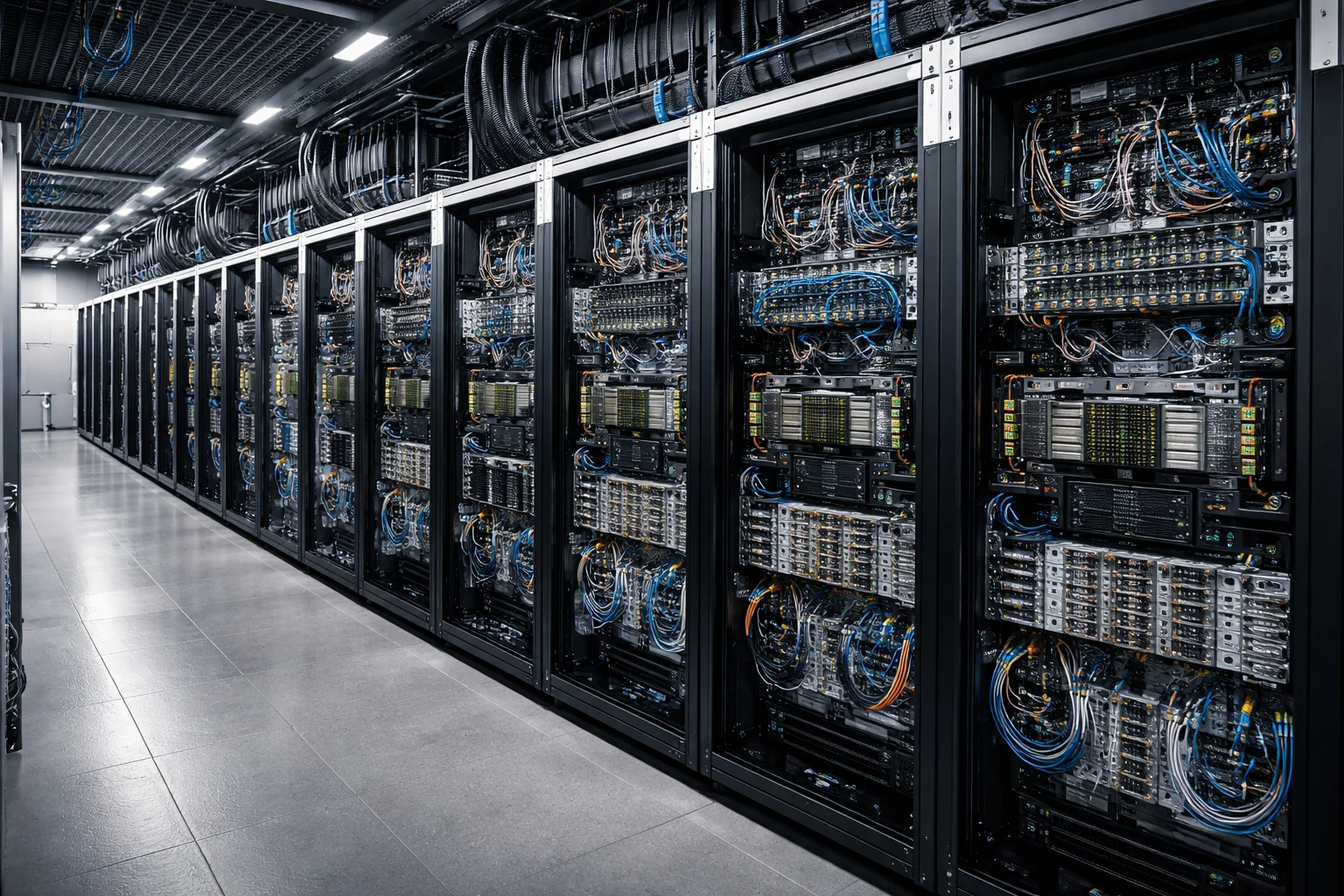
What Modern HPC Servers Actually Look Like in 2026
Introduction
High-performance computing (HPC) servers have undergone fundamental architectural changes as workloads increasingly blur the lines between traditional scientific computing, AI training, and data analytics. For enterprise technology leaders evaluating compute infrastructure in 2026, understanding these modern HPC server architectures is critical for making informed decisions about performance, cost, and operational complexity.
The convergence of AI and scientific computing has reshaped what HPC servers need to accomplish. Where previous generations optimized purely for floating-point operations and memory bandwidth, today's HPC servers must handle diverse workloads spanning tensor operations, large language model inference, molecular dynamics simulations, and real-time data processing. This shift has driven significant changes in processor architectures, memory hierarchies, interconnect technologies, and cooling systems that directly impact enterprise procurement decisions and data center planning.
Background and Context
The evolution from traditional CPU-centric HPC clusters to heterogeneous compute architectures represents the most significant shift in high-performance computing since the move from vector processors to commodity clusters in the 1990s. Early HPC systems prioritized raw computational throughput through highly specialized processors and custom interconnects. The introduction of GPGPU computing around 2007 marked the beginning of accelerated computing, but the real transformation occurred when AI workloads began demanding the same computational resources as traditional scientific applications.
This convergence accelerated after 2020 when organizations realized that the infrastructure requirements for training large neural networks closely matched those needed for computational fluid dynamics, climate modeling, and genomic analysis. The result has been a fundamental rethinking of HPC server design, moving away from homogeneous CPU clusters toward heterogeneous systems that can efficiently handle both traditional HPC workloads and AI/ML tasks within the same infrastructure investment.
The economic drivers behind this evolution are substantial. Organizations like Oak Ridge National Laboratory report that their Frontier exascale system demonstrates 20-30% better price-performance on mixed workloads compared to separate specialized systems. Similarly, companies like NVIDIA have seen enterprise HPC revenue grow by integrating AI acceleration capabilities into traditional scientific computing platforms, indicating strong market demand for converged architectures.
Core Concepts
Modern HPC server architecture in 2026 centers around several key design principles that differentiate these systems from general-purpose servers or cloud computing instances.
Heterogeneous Processing Units form the foundation of contemporary HPC servers. A typical high-end compute node combines traditional CPUs with specialized accelerators in carefully balanced ratios. Current architectures commonly deploy 1-2 high-core-count CPUs (64-128 cores) alongside 4-8 GPU accelerators or specialized AI chips. The CPU handles system management, I/O operations, and workload orchestration, while accelerators process computationally intensive kernels. Intel's Sapphire Rapids and AMD's Genoa processors serve as common CPU foundations, paired with accelerators ranging from NVIDIA's H100/H200 GPUs to Intel's Ponte Vecchio or emerging architectures like Cerebras wafer-scale processors.
Memory Architecture Complexity has increased significantly as systems balance capacity, bandwidth, and latency requirements across different compute units. Modern HPC servers implement multi-tiered memory hierarchies combining DDR5 system memory (typically 512GB-2TB per node), high-bandwidth memory attached to accelerators (80-128GB HBM per GPU), and increasingly, persistent memory technologies for large dataset staging. The memory-to-compute ratio has become a critical design parameter, with AI-focused configurations requiring 2-4GB of memory per accelerator core, while traditional HPC applications may need 8-16GB per CPU core.
Interconnect Technologies have evolved beyond traditional InfiniBand to support the communication patterns of modern workloads. Current HPC servers integrate multiple interconnect layers: high-speed chip-to-chip links (like NVIDIA's NVLink or AMD's Infinity Fabric) for intra-node communication, cluster-level networks (InfiniBand HDR/NDR, Ethernet 400G) for inter-node traffic, and storage networks for data movement. The key innovation is adaptive routing and congestion management that can handle the irregular communication patterns of AI workloads alongside the predictable patterns of traditional simulations.
Power and Cooling Integration has become inseparable from compute architecture as thermal density reaches 40-80kW per rack. Modern HPC servers incorporate sophisticated power management that can dynamically allocate power budgets between CPUs and accelerators based on workload characteristics. Liquid cooling has moved from optional to mandatory for high-density configurations, with direct-to-chip cooling becoming standard for accelerator-heavy nodes.
How It Fits in the Ecosystem
Modern HPC servers exist within a complex ecosystem of software frameworks, orchestration tools, and infrastructure components that has evolved to support heterogeneous computing environments. The relationship between hardware capabilities and software stack optimization has become increasingly tight, with performance depending heavily on how well applications can leverage the full system architecture.
Container orchestration platforms like Kubernetes have been adapted for HPC workloads through projects like Slurm's integration with container runtimes, enabling organizations to run both traditional batch jobs and cloud-native AI workloads on the same infrastructure. This convergence allows enterprises to maximize utilization by running diverse workloads during different time windows or priority levels.
The storage ecosystem has adapted to support the data velocity requirements of modern HPC servers. Parallel file systems like Lustre and GPFS now integrate with object storage backends, while newer architectures incorporate NVMe-over-Fabrics to provide low-latency access to distributed storage. The emergence of computational storage, where storage nodes include processing capabilities, represents a significant architectural shift that affects how HPC servers are deployed and configured.
Software development frameworks have evolved to abstract the complexity of heterogeneous architectures. Programming models like OpenMP offloading, SYCL, and HIP allow applications to target multiple accelerator types from a single codebase, reducing the vendor lock-in concerns that previously complicated HPC procurement decisions. This portability has become a critical factor for enterprises evaluating long-term infrastructure investments.
Current Industry Adoption
Enterprise adoption of modern HPC server architectures varies significantly by sector, with early adopters in energy, financial services, and pharmaceutical industries leading the transition. Oil and gas companies like Shell and ExxonMobil have deployed heterogeneous HPC clusters that can switch between seismic processing during exploration phases and reservoir simulation during production optimization, demonstrating the value of architectural flexibility.
Financial institutions have been particularly aggressive in adopting AI-enabled HPC servers for risk modeling and algorithmic trading. JPMorgan Chase's deployment of GPU-accelerated clusters for Monte Carlo simulations represents a typical approach, where the same infrastructure supports both traditional quantitative analysis and machine learning model training for fraud detection or market prediction.
Manufacturing companies are integrating modern HPC servers into digital twin environments where real-time simulation capabilities support both design optimization and operational decision-making. Companies like Siemens and General Electric use these systems to run computational fluid dynamics for turbine design alongside neural networks that predict equipment maintenance needs.
The research and academic sector has seen the most dramatic architectural evolution, with institutions like Lawrence Livermore National Laboratory and the European Centre for Medium-Range Weather Forecasts deploying exascale systems that demonstrate the scalability potential of heterogeneous architectures. These deployments provide valuable operational data about reliability, power consumption, and application performance that inform enterprise procurement decisions.
Cloud service providers have responded by offering HPC-as-a-Service platforms that abstract the complexity of modern HPC server management. Amazon's ParallelCluster, Microsoft's Azure HPC, and Google's Cloud HPC provide enterprise access to cutting-edge architectures without the capital expenditure and operational complexity of on-premises deployment.
Challenges and Considerations
The complexity of modern HPC server architectures introduces significant operational and economic challenges that enterprises must carefully evaluate. Power and cooling requirements represent the most immediate constraint, with high-density configurations requiring data center infrastructure investments that can exceed the cost of the compute hardware itself. A typical rack of modern HPC servers consuming 60-80kW requires cooling infrastructure that costs $15,000-25,000 per rack beyond the standard data center buildout.
Software optimization complexity has increased substantially as applications must be tuned for multiple processor types within the same system. Organizations often underestimate the engineering effort required to achieve optimal performance across heterogeneous architectures. Performance tuning that previously focused on CPU optimization now requires expertise in GPU programming, memory hierarchy optimization, and interconnect tuning. This skill gap represents a significant hidden cost for enterprises considering advanced HPC deployments.
Reliability concerns emerge from the increased component count and complexity of modern HPC servers. A single compute node with multiple accelerators, complex memory hierarchies, and high-speed interconnects has significantly more failure modes than traditional CPU-only systems. Mean time between failures for high-end HPC nodes typically ranges from 6-18 months depending on configuration, requiring robust fault tolerance and checkpointing strategies that add operational complexity.
Vendor ecosystem fragmentation creates procurement and support challenges as modern HPC servers often require components from multiple suppliers. CPU vendors, accelerator manufacturers, interconnect providers, and system integrators must coordinate compatibility and performance optimization, creating potential integration risks and support complexity. Organizations frequently encounter situations where optimal performance requires specific combinations of hardware and software versions that limit upgrade flexibility.
Cost predictability has become more challenging as workload-dependent power consumption can vary by 2-3x depending on application characteristics. Traditional HPC workloads with predictable computational patterns enable accurate power and cooling planning, while AI workloads with irregular compute and memory access patterns can cause significant variations in operational costs. This variability complicates both capacity planning and budget forecasting for enterprise IT organizations.
Key Takeaways
• Heterogeneous architectures are now standard: Modern HPC servers combine CPUs with specialized accelerators in carefully balanced configurations, requiring organizations to evaluate workload characteristics and performance requirements across multiple processor types rather than focusing solely on traditional CPU metrics.
• Memory hierarchy complexity directly impacts application performance: Multi-tiered memory systems spanning DDR5, HBM, and persistent memory require careful capacity and bandwidth planning, with memory-to-compute ratios becoming as critical as raw computational throughput for procurement decisions.
• Power and cooling infrastructure costs often exceed hardware costs: High-density HPC servers consuming 40-80kW per rack require substantial data center infrastructure investments, with cooling systems and power distribution representing 40-60% of total deployment costs.
• Software optimization expertise has become a critical success factor: Organizations must invest in multi-architecture programming skills and performance tuning capabilities, as achieving optimal performance requires application optimization across CPUs, GPUs, and specialized accelerators simultaneously.
• Operational complexity increases significantly with component diversity: Modern HPC servers have more failure modes and require more sophisticated monitoring and maintenance procedures, with mean time between failures often 2-3x lower than traditional CPU-only systems.
• Workload convergence enables better infrastructure utilization: The ability to run traditional HPC simulations, AI training, and data analytics on the same hardware platform allows organizations to achieve 20-30% better price-performance through improved utilization rates.
• Vendor ecosystem coordination becomes critical for success: Optimal performance and reliability require careful integration of components from multiple suppliers, making vendor relationship management and technical coordination capabilities essential for successful deployments.