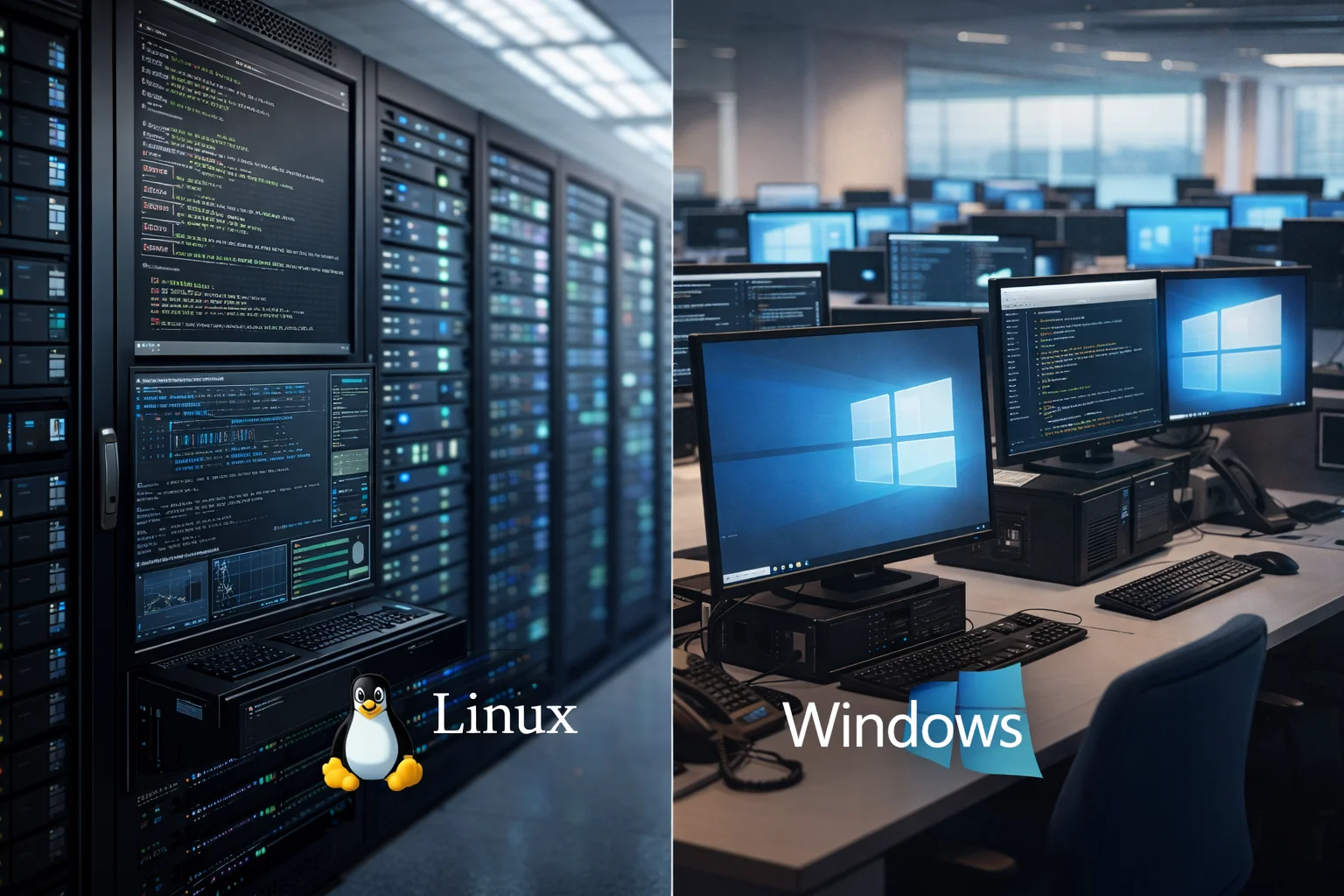
Linux and Windows Are Solving Very Different Problems in 2026
The Linux vs Windows debate has evolved far beyond desktop preference wars. In 2026's enterprise landscape, these operating systems have carved out distinct territories based on fundamentally different architectural philosophies and use case optimizations. Understanding where each excels—and where each struggles—has become critical for technical decision-makers navigating infrastructure choices that can define organizational capabilities for years.
The divergence is more pronounced than ever. Linux dominates cloud infrastructure, containerized workloads, and high-performance computing environments where transparency, customization, and resource efficiency drive value. Windows maintains its stronghold in enterprise desktop environments, legacy application hosting, and development workflows built around Microsoft's ecosystem. Neither is universally superior; they're solving different problems for different operational contexts.
This comparison examines how Linux and Windows have specialized in 2026, analyzing their technical strengths, operational tradeoffs, and the decision criteria that determine optimal fit for specific enterprise needs.
Linux Overview
Linux operates as a Unix-like kernel foundation supporting hundreds of distributions, each optimized for specific use cases. The open-source model enables deep customization, from embedded systems running minimal configurations to high-performance computing clusters managing thousands of nodes. Major enterprise distributions—Red Hat Enterprise Linux, Ubuntu LTS, SUSE Linux Enterprise—provide commercial support while maintaining the core flexibility that defines Linux's architectural advantage.
The containerization revolution has cemented Linux's position in cloud-native infrastructure. Docker containers, Kubernetes orchestration, and serverless computing platforms overwhelmingly run on Linux due to its lightweight process model and namespace isolation capabilities. Amazon Web Services reports that over 85% of EC2 instances run Linux variants, with similar patterns across Google Cloud Platform and Microsoft Azure.
Linux excels in environments requiring precise resource control and transparent operation. The ability to strip unnecessary services, customize kernel parameters, and directly manage hardware resources makes Linux the default choice for performance-critical applications. Financial trading systems, scientific computing clusters, and real-time data processing pipelines rely on Linux's deterministic behavior and minimal overhead.
The programming environment advantages are substantial. Native development tools, comprehensive package managers, and seamless integration with version control systems create efficient workflows for software development. Companies like Netflix, Spotify, and Airbnb have built their entire technology stacks on Linux, leveraging its stability for high-availability services that process millions of requests daily.
Windows Overview
Windows Server has evolved into a comprehensive platform optimized for enterprise applications, Active Directory integration, and hybrid cloud scenarios. The Windows ecosystem excels at providing consistent management interfaces, centralized policy enforcement, and seamless integration across desktop and server environments. Organizations with significant Microsoft technology investments find Windows Server essential for maintaining operational coherence.
The strength of Windows lies in its application compatibility and enterprise tooling integration. Legacy line-of-business applications, particularly those built on .NET Framework, SharePoint, or SQL Server, often require Windows Server environments. Microsoft's PowerShell automation framework and System Center management tools provide sophisticated operations capabilities that many enterprises have standardized around.
Windows desktop environments remain dominant in enterprise settings due to Office 365 integration, Active Directory authentication, and group policy management. The ability to centrally manage thousands of workstations, deploy applications through established channels, and maintain security compliance through familiar tools represents significant operational value for large organizations.
Developer productivity on Windows has improved dramatically with Windows Subsystem for Linux (WSL), Visual Studio Code, and enhanced terminal capabilities. Microsoft's embrace of cross-platform development has made Windows a viable development environment for applications that ultimately deploy on Linux, though the workflow typically involves additional complexity compared to native Linux development.
Technical Comparison
| Feature | Linux | Windows Server |
|---|---|---|
| Resource Overhead | Minimal (100-200MB base) | Higher (2-4GB typical) |
| Container Performance | Native, optimized | Improving, but overhead remains |
| Hardware Compatibility | Extensive, community-driven | Curated, vendor-certified |
| Security Model | Permissions-based, granular | ACL-based, group policy integration |
| Customization Depth | Kernel-level modification possible | Limited to supported configurations |
| Management Tools | Command-line first, GUI optional | GUI-first, PowerShell automation |
| Licensing Model | Open source (support costs) | Per-core/CAL licensing |
| Update Mechanisms | Package managers, rolling/point releases | Windows Update, WSUS integration |
| Virtualization | KVM, Xen native support | Hyper-V integration, VMware certified |
| Networking Stack | Highly configurable, multiple options | Integrated, Windows-optimized |
Performance and Scale Considerations
Linux demonstrates superior performance characteristics in high-concurrency scenarios due to its efficient process scheduling and memory management. The Linux kernel's completely fair scheduler and memory overcommit capabilities enable higher density deployments. Google's internal studies show Linux systems achieving 40-60% better resource utilization compared to Windows in containerized environments.
At extreme scale, Linux's modular architecture becomes decisive. Supercomputing installations exclusively use Linux variants because the ability to remove unnecessary kernel modules and optimize for specific hardware configurations directly impacts performance. The Top500 supercomputer list shows 100% Linux adoption, reflecting the platform's scalability advantages in compute-intensive workloads.
Windows Server performs competitively in scenarios aligned with its design assumptions. Applications leveraging Windows-specific APIs, COM+ services, or .NET runtime optimizations can achieve excellent performance on Windows Server. Microsoft SQL Server running on Windows Server often outperforms the same database on Linux due to deeper OS integration and optimization.
However, Windows encounters scaling limitations in containerized environments. Windows containers require significantly more memory overhead, and the Windows Server licensing model creates cost pressures that become prohibitive at large scale. Organizations deploying thousands of microservices typically find Linux's resource efficiency and zero-licensing-cost model economically compelling.
Cost and Operational Factors
Total cost of ownership calculations reveal distinct patterns. Linux eliminates licensing fees but shifts costs to support contracts, staff expertise, and operational tooling. Red Hat Enterprise Linux support typically costs $1,000-$2,500 per server annually, while Windows Server Standard licensing starts at $1,000 per 16-core license plus client access licenses.
The operational complexity varies by organizational context. Teams with strong Unix/Linux expertise find Linux systems more transparent and debuggable. The ability to examine source code, modify configurations at granular levels, and leverage decades of Unix operational knowledge creates efficiency advantages. Companies like Digital Ocean and Linode have built their entire infrastructure operations around Linux expertise.
Windows Server environments benefit from centralized management tools and consistent interfaces. Organizations with existing Active Directory infrastructure, System Center deployments, and Windows-trained staff often find Windows Server integration reduces operational complexity despite higher licensing costs. The ability to manage servers through familiar graphical interfaces and established change management processes represents significant value.
Staff expertise requirements differ substantially. Linux administration demands command-line proficiency, understanding of shell scripting, and familiarity with diverse configuration approaches across distributions. Windows Server administration relies more on GUI tools, PowerShell scripting, and Microsoft-specific technologies. The job market reflects these differences, with Linux expertise commanding premium salaries in cloud infrastructure roles.
Security operational models also diverge. Linux security focuses on minimal attack surfaces, principle of least privilege, and transparent configuration management. Windows Server security emphasizes centralized policy enforcement, integrated authentication, and compliance framework integration. Neither approach is inherently superior, but they require different operational capabilities and tooling investments.
When to Choose Each
Linux becomes the optimal choice when containerization, cloud-native architectures, or high-performance computing drive infrastructure requirements. Organizations building microservices, deploying applications at massive scale, or requiring precise hardware optimization find Linux's flexibility and resource efficiency decisive. The programming environment advantages make Linux essential for teams developing distributed systems, data processing pipelines, or real-time applications.
Companies with substantial open-source technology stacks—using PostgreSQL, Redis, Elasticsearch, or Kafka—benefit from Linux's native integration with these systems. The ability to run the same operating system across development, testing, and production environments eliminates compatibility issues and simplifies deployment pipelines.
Windows Server remains necessary when legacy application compatibility, Active Directory integration, or Microsoft ecosystem investment drives requirements. Organizations with extensive SharePoint deployments, Exchange infrastructure, or .NET Framework applications often find migration costs prohibitive compared to continued Windows Server usage.
Hybrid scenarios are increasingly common. Many enterprises run Linux for web applications, databases, and container platforms while maintaining Windows Server for Active Directory, file services, and legacy applications. This approach optimizes each platform's strengths while managing transition complexity.
The decision frequently comes down to team expertise and operational tooling investments. Organizations with strong Unix/Linux capabilities can leverage Linux's advantages more effectively, while teams trained on Microsoft technologies may find Windows Server integration reduces operational risk despite higher costs.
Key Takeaways
• Linux excels in cloud-native, containerized, and high-performance computing environments where resource efficiency and customization capabilities directly impact operational success and cost structure.
• Windows Server remains essential for organizations with significant Microsoft ecosystem investments including Active Directory, legacy .NET applications, and established Windows-based operational workflows.
• Performance characteristics favor Linux for high-concurrency scenarios while Windows Server performs competitively in applications designed around Microsoft-specific optimizations and APIs.
• Total cost calculations must include licensing, support, and staffing costs with Linux typically showing advantages at large scale despite support contract requirements.
• Operational complexity varies by organizational context with Linux requiring deeper technical expertise but providing greater transparency and troubleshooting capabilities.
• Hybrid approaches are increasingly practical allowing organizations to optimize each platform's strengths while managing legacy compatibility and transition costs.
• The choice often reflects team expertise and existing tooling investments more than technical superiority, with both platforms capable of supporting enterprise-grade applications when properly implemented.