Summary
Server refreshes routinely strand useful DDR4. The processors move on, the platforms switch to DDR5, and racks of registered DIMMs become spares or secondary-market inventory even when the modules still have plenty of service life. A new CXL 2.0 add-in card from Penguin Solutions turns that mismatch into a practical infrastructure option: put the old DIMMs behind a CXL memory controller and attach them to a newer server over PCIe 5.0.[1][2]
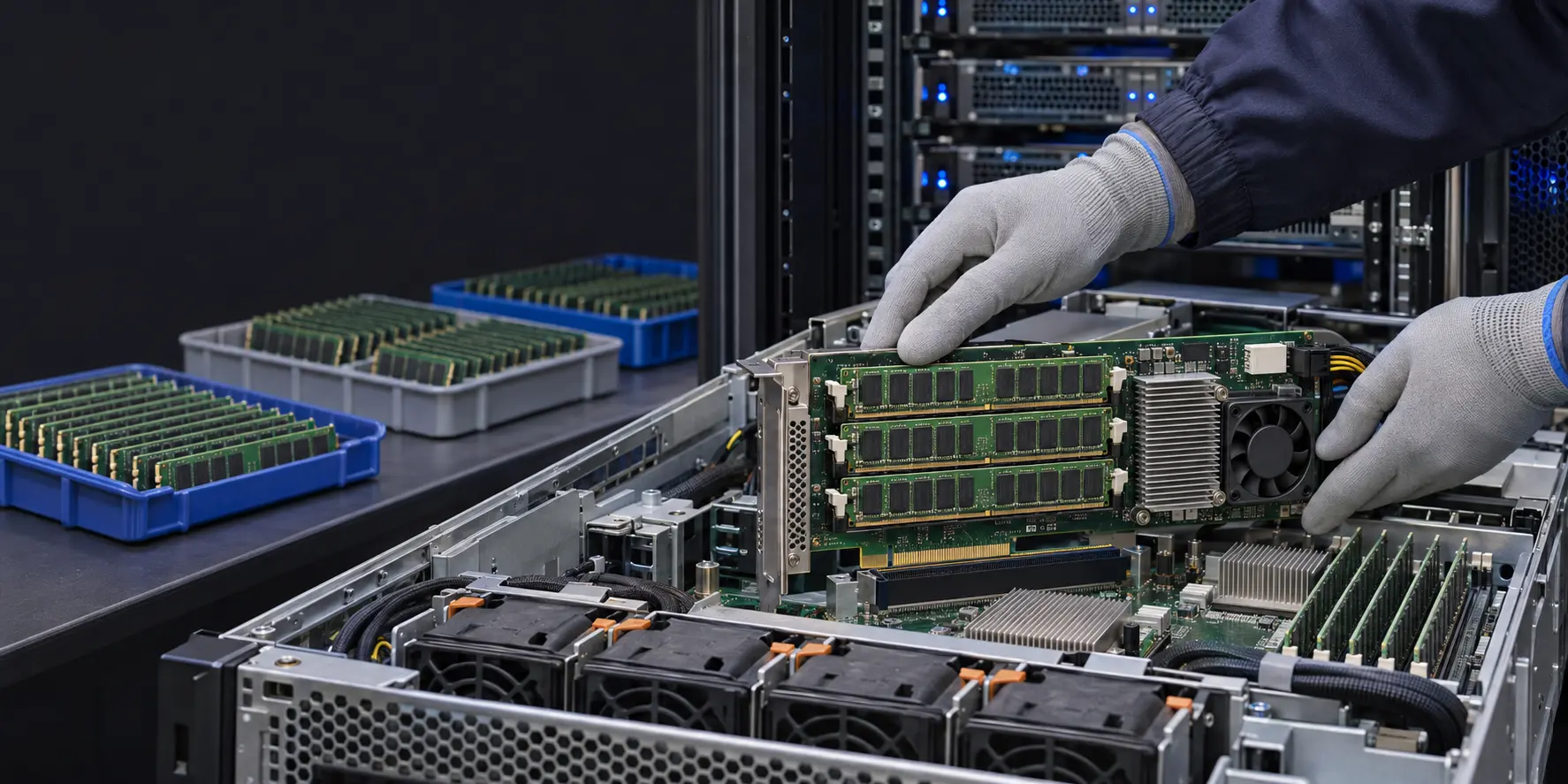
The card is not a magic adapter that makes DDR4 behave like local DDR5. It creates another memory tier. Penguin lists a full-height, half-length, dual-width card with four DDR4 channels, support for as many as eight RDIMMs, capacities up to 1 TB and up to 64 GB/s across its PCIe 5.0 x16 host interface.[2] Access still travels through a CXL controller and link, so latency, bandwidth and software placement matter.
That trade can make sense for workloads with a large cold or warm memory set: inference KV caches, in-memory databases, virtual machines, graph processing and some scientific applications. It can also fail badly when a latency-sensitive working set spills into the slower tier. The useful story is not that obsolete memory is suddenly fast again. It is that CXL finally gives operators a standardized place to put capacity that would otherwise sit idle.
What the card changes
CXL Type 3 devices are memory expanders. The host discovers and manages them through CXL.io, then performs loads and stores against device memory through CXL.mem.[3] To software, properly configured capacity can appear in the system's physical address space rather than behind a storage or network API. That is the important difference between a CXL card and a box that exposes old motherboards through RDMA.
Penguin's CXA-8F2W-D4 is a concrete version of that model. It accepts DDR4-3200 RDIMMs or a smaller number of high-capacity load-reduced DIMMs. The company offers populated configurations and says customer-owned modules can go through inspection, functional testing, characterization and validation in a compatible host before shipment.[1][2]
The reuse program matters as much as the board. Used memory is not automatically production memory. Modules pulled from several server generations may have different vendors, ranks, thermal histories and error behavior. A tray of DIMMs that passes a quick boot test is not the same thing as a validated 24/7 configuration. Penguin's screening claims are vendor claims, and buyers should ask for the actual test profile, rejection criteria, supported part list and warranty terms. Still, the basic operational approach is sound: qualify the media and the fully populated card together, then validate that combination in the target platform.
Compatibility is the first hard gate. The product is for CXL 2.0-capable hosts; a PCIe 5.0 slot by itself does not prove that a server firmware exposes the required CXL memory features. Operators need confirmed CPU, board, BIOS and operating-system support. They also need enough physical space, airflow and power for a dual-width card with an auxiliary 12-volt connection.[2] In a dense GPU server, those may be scarcer than memory.
Capacity and bandwidth are different purchases
One terabyte on a card sounds like a straightforward memory upgrade. It is better understood as a capacity purchase with a bandwidth ceiling. The advertised 64 GB/s host-interface figure is aggregate link throughput, not a promise that every application will read DDR4 at that rate.[2] Protocol overhead, controller behavior, contention and access patterns all sit between the headline number and application performance.
A two-socket server can have many native DDR5 channels operating in parallel. CXL-attached memory on one x16 link cannot replace that local bandwidth. It also adds controller and link latency. The CXL Consortium's own hyperscale discussion is blunt about the design rule: keep the common case in fast memory. If an application goes to the slower tier for every read, performance will suffer. If it reaches that tier rarely, the extra delay may disappear into overall runtime noise.[4]
This is why placement policy decides whether the hardware is useful. Hot code, active database pages, frequently accessed embeddings and latency-critical allocator metadata should stay in local DRAM. Colder pages can move outward. Linux can expose CXL memory as a separate NUMA node, and tiering policies can use access information to promote and demote pages. Applications that already understand NUMA placement may manage the split directly. Others will depend on kernel policy or a runtime layer.
None of those choices should be accepted on faith. A fleet team should measure memory latency and sustainable bandwidth per node, then run the real application with several local-to-CXL ratios. Average throughput is not enough. Tail latency, page-fault behavior, migration traffic and memory pressure can reveal a bad tiering policy long before a capacity dashboard does.
Where reused DDR4 can earn its slot
Inference is the most obvious current target, but the fit is narrower than the marketing language suggests. Large language model serving can retain substantial KV-cache state as conversations grow. Keeping every inactive session in accelerator HBM is expensive. Moving colder state into host memory can preserve capacity for active work, and CXL can expand that host tier. The benefit depends on cache locality and the cost of moving data back toward the accelerator. A card does not remove the PCIe transfers or make DDR4 an HBM substitute.
In-memory databases have a similar split. A large buffer pool may contain a relatively small hot set and a long tail of colder pages. CXL capacity can be attractive if the database, operating system or memory manager can keep frequently touched pages local. A uniform allocation policy can produce the opposite result: more nominal memory and worse transaction latency.
Virtualization may be a cleaner use case. Hosts are often provisioned for aggregate guest capacity while many allocated pages remain cold. An additional tier can improve consolidation if the hypervisor and host kernel place pages intelligently and if the service-level agreement tolerates the slower path. It also changes the failure model. Losing one expansion card can affect a large amount of guest memory at once, so RAS reporting, poison handling and evacuation procedures need deliberate tests.
HPC workloads vary too much for a general promise. Sparse graph analytics, large reference datasets and checkpoint staging may value capacity. Tight stencil loops and bandwidth-bound solvers may not. Teams should profile memory access before buying hardware, not after. A working set that streams continuously through the CXL tier is a warning sign.
Reuse does not erase lifecycle costs
The environmental case sounds simple: keep working DIMMs out of the waste stream. The accounting is more complicated. Reuse adds a controller, board, cooling load and qualification process. Older DDR4 may also deliver less capacity per watt than a new dense DDR5 configuration. The answer depends on what equipment is already owned, how much new capacity would otherwise be purchased and whether the server has an unused slot without sacrificing a more valuable accelerator or network interface.
Procurement teams should calculate cost per usable gigabyte after screening fallout, card cost, support and power. They should also price operational complexity. A mixed fleet with several DIMM populations can become difficult to patch, spare and troubleshoot. Standardized card configurations and strict firmware baselines can keep a reuse project from turning into a collection of exceptions.
Error history belongs in that calculation. Preserve serial-level test records when possible, establish corrected-error thresholds and decide when a module or whole card leaves service. Watch temperatures around the add-in card under sustained traffic. A memory tier that passes a short benchmark but accumulates errors during a week-long run is not a bargain.
A sensible qualification plan
Start with one compatible host and one fixed DIMM population. Confirm that firmware enumerates the device consistently across cold boots, warm reboots and updates. Check that Linux reports the expected capacity and NUMA topology, then verify machine-check and CXL event reporting before running application tests.
Benchmark local and CXL memory separately. Record loaded latency, read and write bandwidth, CPU overhead and performance under simultaneous I/O or accelerator traffic. PCIe topology matters: a CXL card sharing root-complex resources with a GPU or high-speed NIC can behave differently from an isolated lab result.
Next, force realistic failures. Remove capacity from the workload, inject supported errors, reboot during load and test the recovery path after a card or DIMM replacement. If the platform supports memory hot-plug or dynamic provisioning, verify the exact operating-system and orchestration behavior rather than assuming that standards support guarantees a smooth fleet workflow.
Finally, compare application-level results at several tier sizes. Track throughput and p95 or p99 latency alongside local-memory hit rate and page migration. The CXL Consortium identifies three adoption constraints: cost must beat ordinary memory, serviceability must resemble native DRAM, and the software stack must use the slower tier without damaging applications.[4] Those are good acceptance criteria for a pilot.
Direct expansion now, pooled memory later
The immediate product is a direct-attached CXL card. Marvell and Penguin have also described future appliances that could pool memory across hosts and, later, use a photonic fabric across racks.[5] Those plans should not be confused with what operators can qualify today. The companies say their photonic systems are expected to sample in the second half of 2027, and independent reporting describes a much more ambitious architecture involving shared DDR5 and HBM.[5]
Direct attachment is less dramatic and easier to reason about. One server owns a visible memory device. The failure domain is bounded, the topology is measurable and the application can be tested against a known local-to-CXL ratio. Memory pooling may eventually improve utilization across a rack, but it adds fabric management, allocation and larger shared failure domains.
Reused DDR4 is therefore a useful sign of CXL's progress precisely because it is ordinary. It takes a pile of known server components, adds a standards-based controller and creates a tier that existing operating systems can begin to manage. For infrastructure teams, the decision comes down to workload shape and validation discipline. Buy it for cheap, testable capacity. Do not buy it expecting old DIMMs on a PCIe card to perform like native memory.