Summary
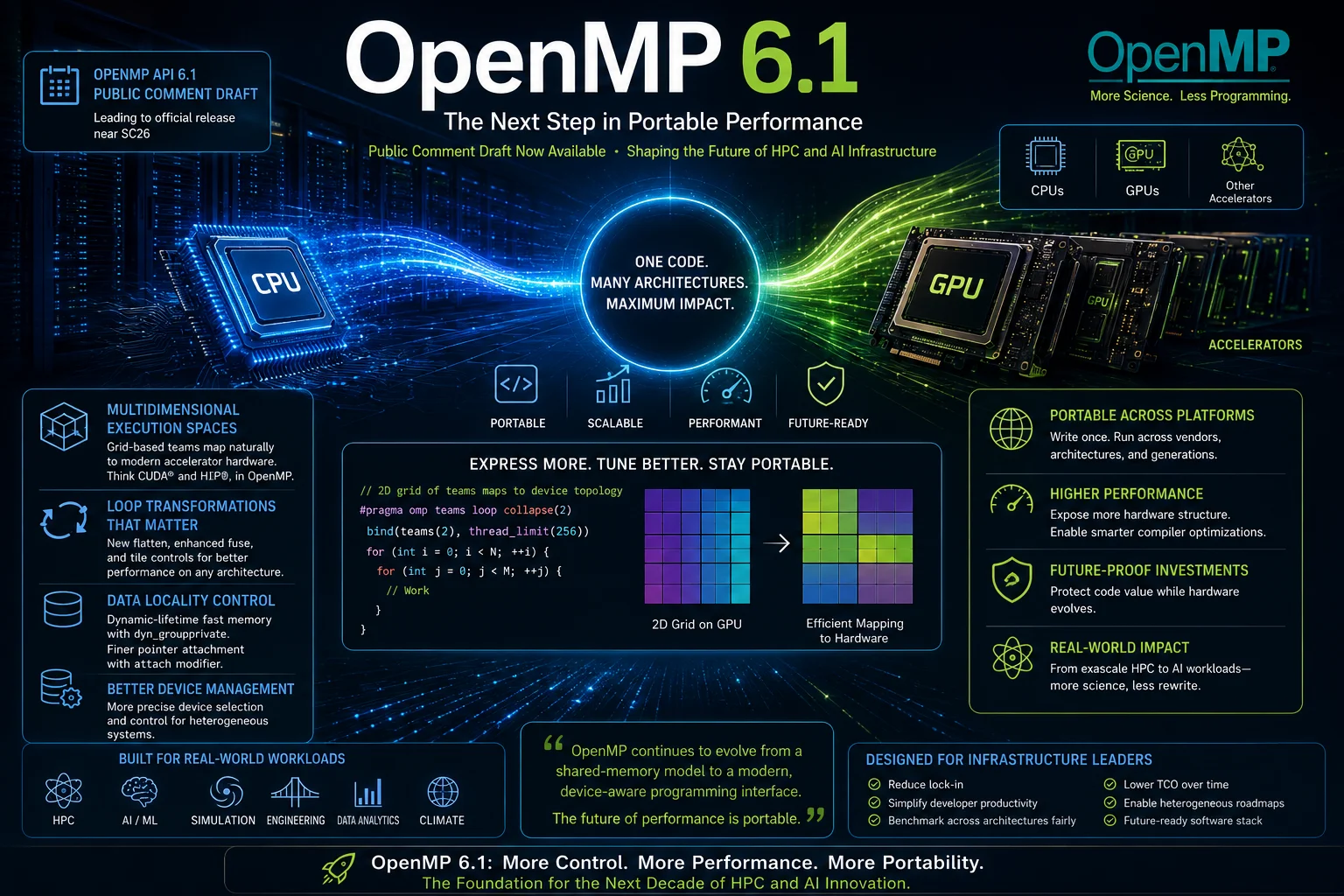
OpenMP Technical Report 15, the public comment draft for OpenMP API 6.1, is a useful signal for infrastructure leaders because it shows where portable accelerator programming is heading. The draft adds multidimensional execution spaces, support for dynamic-lifetime data in fast device memory, expanded loop transformations, better pointer attachment controls, improved device selection, scalable SIMD support, and more detailed affinity behavior.
Those sound like language-level details, but the operational meaning is broader. HPC and enterprise AI infrastructure teams are trying to keep code portable across CPUs, GPUs, and other accelerators while still extracting performance from increasingly complex nodes. OpenMP 6.1 does not erase the need for CUDA, HIP, SYCL, MPI, vendor libraries, or careful profiling. It does, however, continue OpenMP's shift from a shared-memory CPU directive model toward a more explicit, device-aware programming interface.
The important question is not whether every codebase should adopt the draft immediately. It is whether the proposed features close enough of the gap between portable source code and real accelerator topology to be worth planning for in compilers, application roadmaps, and procurement benchmarks.
Why this draft matters now
OpenMP has long been valuable because it lets scientific and engineering teams express parallelism without rewriting entire applications around one hardware vendor's programming model. That portability is attractive to organizations that run code for many years, move workloads between clusters, or need a common model for mixed CPU and accelerator systems.
But modern accelerator nodes have stretched the older abstraction. A current HPC or AI server is not simply a multicore host with a faster coprocessor. It may include multiple GPUs, high-bandwidth memory domains, NUMA effects, coherent and non-coherent links, hierarchical interconnects, fast scratchpad-style memories, and device placement rules that affect whether a job is efficient or painfully expensive. A directive model that hides too much of that structure can protect portability while also preventing useful tuning.
The OpenMP 6.1 public comment draft is important because several additions expose more of the structure programmers need without forcing them to abandon standard OpenMP. The draft is expected to lead into the formal 6.1 release near SC26. That gives compiler vendors, laboratory teams, ISVs, and infrastructure planners time to test the direction before making hard commitments.
Multidimensional execution spaces bring OpenMP closer to accelerator reality
The headline feature is support for multidimensional execution spaces. OpenMP describes this as extensions to existing parallel constructs and new dimension routines that enable a grid-based view of teams on a device. The comparison to CUDA and HIP is unavoidable: many accelerator workloads are naturally described as one-, two-, or three-dimensional grids rather than as a single flat loop.
That matters for stencils, finite element methods, weather and climate models, computational fluid dynamics, image processing, lattice methods, and many AI-adjacent numerical kernels. Developers often reason about these workloads in terms of tiles, blocks, planes, halos, and neighborhoods. When the programming model can represent those dimensions more directly, there is less need to flatten structure manually and then reconstruct it through index arithmetic.
For enterprise infrastructure teams, this is not only a developer convenience. Cleaner expression of grid-shaped work can make performance reviews more transparent. It can also make it easier to compare compiler behavior across platforms because the source code carries more of the programmer's intent.
Loop transformations are becoming infrastructure features
OpenMP 6.1's draft loop-transformation work includes a new flatten directive, expanded fuse behavior with a depth clause, and a modifier for specifying the number of tiles. These are not cosmetic additions. Loop structure is one of the main places where portability and performance collide.
On CPUs, loop transformations affect vectorization, cache locality, prefetch behavior, and NUMA traffic. On accelerators, they also affect occupancy, memory coalescing, shared-memory use, register pressure, and how work maps onto device execution units. When a transformation is written manually, the code can become difficult to read and brittle across architectures. When it is expressed through a standard directive, compilers have a clearer contract and the code remains closer to the original algorithm.
The practical value will depend on compiler quality. A directive does not guarantee a fast kernel. But standardizing more transformation intent helps teams build benchmark suites that test compilers against real application patterns. It also gives procurement teams a better way to ask whether a platform performs well on portable source, not only on hand-tuned vendor examples.
Data locality is the real battleground
The draft's dyn_groupprivate feature and related API routines are aimed at dynamic-lifetime data that can use small, fast memory on devices. The attach modifier for the map clause gives programmers more control over pointer attachment for mapped data. These changes address a recurring problem in heterogeneous systems: moving compute to an accelerator is often easier than placing the right data near that compute at the right time.
Data movement dominates many accelerator workloads. A kernel that is arithmetically impressive but constantly waits on memory transfers is not a useful outcome. The same is true when pointer-heavy applications behave differently across compilers because mapping semantics are not explicit enough.
For teams modernizing large C, C++, and Fortran applications, these details matter. Legacy HPC codes often include nested data structures, dynamic allocation, and domain-specific memory layouts that were not designed for device offload. More precise OpenMP controls can reduce the amount of invasive restructuring required to test accelerator paths.
That does not mean the migration becomes automatic. Teams still need profiling, correctness tests, memory-transfer analysis, and architecture-specific tuning. But a richer standard gives them more options before they fall back to non-portable rewrites.
Affinity controls reflect how nodes are actually built
OpenMP 6.1 also expands thread-affinity controls. The draft describes extensions to OMP_PLACES for hierarchical place groups and structured places, spread-affinity behavior over that hierarchy, and OMP_PROC_BIND reset and noreset modifiers that control whether original affinity is restored after a parallel region.
Affinity sounds mundane compared with accelerators, but it remains critical in dense servers. CPU sockets, chiplets, memory controllers, PCIe roots, CXL devices, NICs, and accelerators all create locality effects. A job can lose performance if host threads, memory allocation, and device work are placed without regard to topology.
These controls should interest both HPC administrators and enterprise platform engineers. The more precise the application-level affinity model becomes, the easier it is to align scheduler policy, runtime behavior, and node architecture. That alignment is especially relevant when multiple tenants share expensive accelerator partitions or when batch jobs are expected to deliver predictable throughput.
Scalable SIMD and device selection point to heterogeneous fleets
The scaled modifier for simdlen is intended to support scalable SIMD instructions. That is relevant because vector length is no longer something every application can assume statically. Architectures such as Arm SVE and other scalable-vector designs encourage code that adapts to implementation-specific vector widths.
The new omp_get_device_distances routine is another infrastructure-facing feature. Device selection is often treated as a runtime convenience, but in heterogeneous nodes it can materially affect performance. Distance between devices, memory, and host resources influences transfer cost and synchronization behavior. Exposing more information to guide device constructs helps applications make placement decisions that are closer to the physical system.
For cluster operators, this is part of a larger trend: applications increasingly need topology information that used to live only in scheduler configuration, fabric diagrams, or vendor tools. Standards that expose useful topology hints can make heterogeneous fleets less fragile.
What teams should do before adopting
No organization should treat a public comment draft as a production mandate. The right response is measured preparation.
First, compiler and toolchain teams should track support in the compilers they already use. OpenMP feature availability has always varied by compiler, version, target architecture, and offload backend. A feature listed in a specification is not automatically usable on a production cluster.
Second, application owners should identify kernels where the new model could matter: multidimensional loop nests, pointer-heavy mapped data, dynamic device-local working sets, scalable-vector opportunities, or affinity-sensitive hybrid MPI/OpenMP regions. Those kernels make good candidates for small experiments once compiler support appears.
Third, infrastructure teams should update benchmark methodology. It is not enough to run vendor-tuned samples. If the enterprise value proposition is portability, benchmarks should include representative OpenMP code paths and should measure not only peak throughput but also development effort, compiler maturity, correctness, and portability across systems.
Finally, procurement teams should ask vendors specific questions. Which OpenMP 6.0 features are supported today? What is the roadmap for 6.1 draft features? Which offload targets are tested? How are affinity and device-distance features integrated with the platform topology? What debugging and profiling tools understand the generated code?
The enterprise takeaway
OpenMP 6.1's public comment draft is not a revolution, and that is a strength. It is a standards-driven refinement aimed at problems that real heterogeneous systems already expose: grid-shaped accelerator work, loop locality, dynamic device memory, pointer mapping, affinity, scalable vectors, and device placement.
For HPC centers, research labs, engineering software vendors, and enterprises building accelerator-backed platforms, the draft is worth watching because it makes portability more concrete. The winners will not be the teams that chase every new directive first. They will be the teams that use the standard to preserve codebase longevity while building disciplined tests around the parts of their workloads where topology and data movement decide the bill.