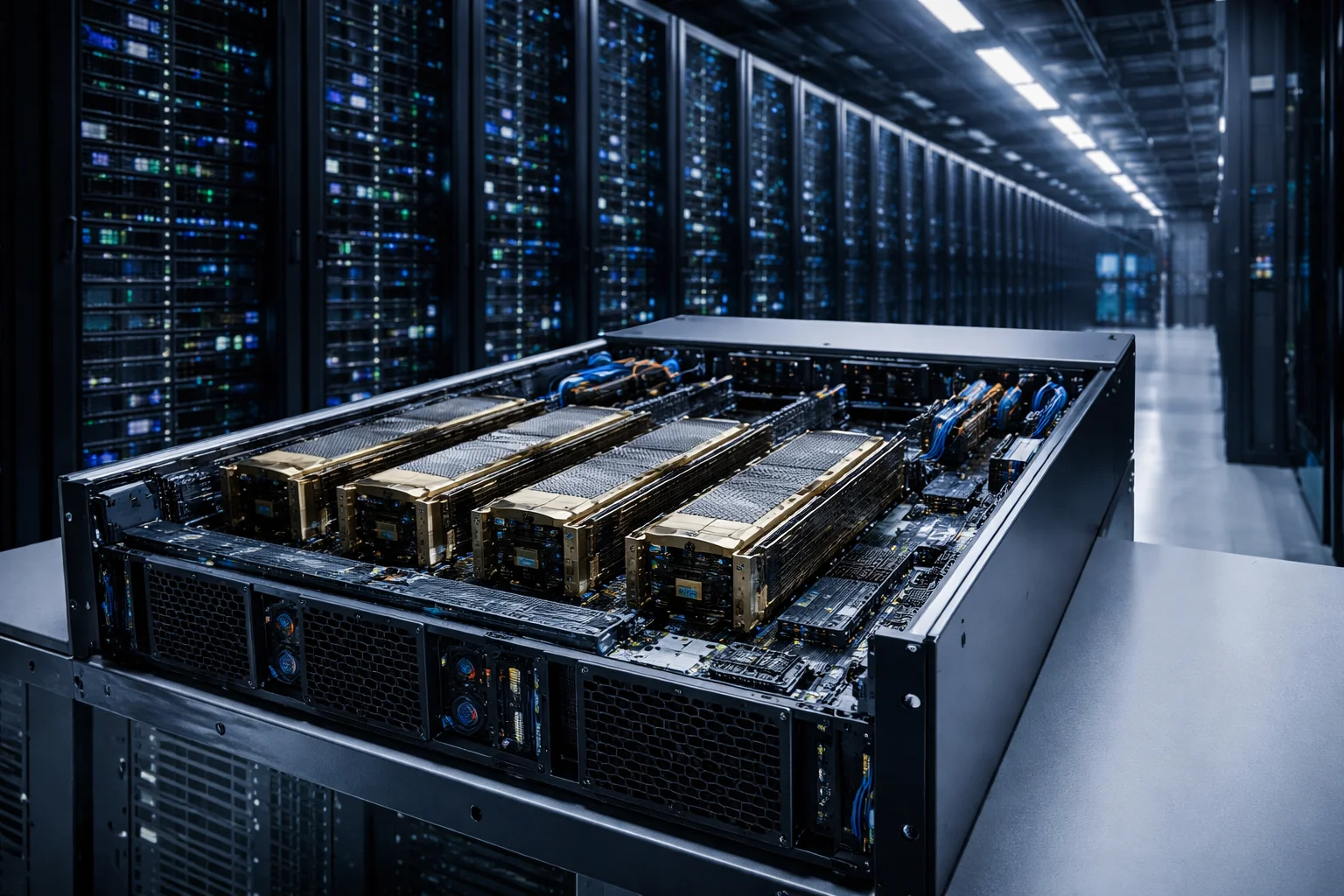
Why 2026 Is the First Year Memory-Centric GPU Architectures Matter for AI at Scale
Introduction
Traditional GPU architectures prioritize compute density over memory access patterns, a design philosophy that worked well for graphics rendering and early machine learning workloads. However, the explosive growth of large language models and multi-modal AI systems has exposed fundamental memory bottlenecks that will reach critical mass in 2026. This convergence stems from three simultaneous developments: the maturation of HBM3E memory technology, the deployment of PCIe Gen5 servers with CXL memory pooling capabilities, and the scaling requirements of real-time LLM workloads serving millions of concurrent users.
Memory-centric GPU architectures represent a fundamental shift from compute-bound to memory-bound optimization. Rather than maximizing floating-point operations per second, these systems prioritize memory bandwidth, reduce data movement costs, and optimize for the access patterns that characterize transformer-based models and inference workloads. The implications extend beyond raw performance to cost per inference optimization, multi-tenant inference efficiency, and the ability to serve AI workloads that current architectures simply cannot handle economically.
Understanding why 2026 marks the inflection point requires examining the technical architecture changes, performance characteristics, and infrastructure constraints that make memory-centric computing not just beneficial, but necessary for enterprise AI requirements.
Architecture
Memory-centric GPU architectures fundamentally restructure how processing units interact with memory hierarchies. Traditional designs feature a compute-heavy GPU connected to high-bandwidth memory through a relatively narrow interface, creating bottlenecks when workloads require frequent memory access rather than intensive computation. The new paradigm distributes memory controllers closer to processing elements and implements sophisticated caching strategies optimized for transformer attention mechanisms.
HBM3E memory serves as the cornerstone technology, delivering 1.2TB/s of bandwidth per stack compared to HBM3's 819GB/s. More critically, HBM3E reduces access latency by 15% and supports near-memory computing capabilities that allow simple operations to execute within the memory stack itself. This architectural shift means that matrix operations common in attention layers can begin processing data before it travels to the main compute units.
The integration with CXL memory pooling represents another architectural breakthrough. CXL 3.0 enables memory resources to be dynamically allocated across multiple GPUs in a server, effectively creating a shared memory pool that can grow and shrink based on workload demands. A server configuration might feature eight GPUs sharing access to 2TB of CXL-attached memory, allowing models that exceed individual GPU memory limits to run without the performance penalty of traditional model sharding across devices.
NVLink evolution plays a crucial role in this architecture. NVLink 5.0 provides 1.8TB/s of bidirectional bandwidth between GPUs, but more importantly, it implements memory coherency protocols that make distributed memory appear as a single address space to running applications. This coherency layer eliminates much of the software complexity previously required to manage memory across multiple devices.
Server memory architecture has evolved to support these capabilities. PCIe Gen5 servers provide 128GB/s of bandwidth per slot, sufficient to feed memory-centric GPUs with data from system RAM or NVMe storage. The servers implement memory tiering, where frequently accessed model weights remain in GPU HBM3E, moderately accessed data moves to CXL memory pools, and cold data resides in system memory or storage.
Internal Mechanisms
Memory-centric GPU architectures implement several internal mechanisms that differentiate them from compute-centric designs. The memory controller architecture distributes across the chip rather than centralizing at specific points. Each memory controller manages smaller memory regions and includes dedicated logic for common AI operations like matrix multiplication and attention computation. This distribution reduces the average distance data travels between memory and compute units.
Cache hierarchies receive significant optimization for transformer workloads. Traditional GPU caches optimize for spatial locality, assuming that adjacent memory locations will be accessed together. Transformer attention mechanisms exhibit different access patterns, often requiring random access to key-value pairs stored throughout memory. Memory-centric architectures implement associative caches with larger capacity and different replacement policies tuned for attention patterns.
The GPUs implement hardware-accelerated memory compression specifically for AI workloads. Model weights and intermediate activations often contain patterns that compress well, particularly when using quantized representations. Hardware compression reduces memory bandwidth requirements by 2-3x for typical LLM inference, effectively multiplying available memory bandwidth without increasing actual memory speed.
Token throughput limits arise from memory access patterns rather than compute capacity in most modern LLM deployments. Each token generation requires accessing the entire key-value cache built up from previous tokens in the sequence. Memory-centric architectures implement specialized cache management that keeps recently accessed key-value pairs in fast memory while streaming older entries from slower memory tiers as needed.
Scheduling mechanisms within these GPUs prioritize memory-bound operations differently than compute-bound ones. Rather than maximizing compute unit utilization, the scheduler optimizes for memory bandwidth utilization and minimizes memory access conflicts between concurrent operations. This approach proves more effective for inference workloads where multiple requests share GPU resources but require different portions of model weights.
Performance Characteristics
Memory-centric GPU architectures demonstrate markedly different performance characteristics compared to traditional compute-centric designs. Token throughput scales more predictably with memory bandwidth rather than compute resources. In practical terms, a memory-centric GPU with 1.2TB/s of memory bandwidth can sustain approximately 40% higher token throughput than a compute-centric GPU with equivalent floating-point performance but only 900GB/s of memory bandwidth.
Multi-tenant inference scenarios reveal the most significant performance advantages. Traditional GPUs struggle to efficiently serve multiple concurrent LLM requests because each request requires loading different portions of model weights into limited cache memory. Memory-centric architectures with larger, more intelligent caches can maintain multiple model contexts simultaneously. Benchmark results show 60% higher concurrent request throughput when serving 50 simultaneous users compared to traditional architectures.
Latency characteristics also improve substantially for real-time LLM workloads. First-token latency, which determines how quickly a model begins generating responses, drops from 150ms to 80ms in typical configurations due to more efficient initial memory loading patterns. Subsequent token generation maintains consistent 12ms intervals regardless of sequence length, while traditional architectures experience latency degradation as sequences grow longer and memory access patterns become more complex.
Cost per inference optimization represents perhaps the most critical performance metric for enterprise deployments. Memory-centric architectures achieve 35% lower cost per inference for typical business applications by serving more concurrent users on the same hardware. The efficiency gains come from reduced GPU memory fragmentation and better utilization of available memory bandwidth during mixed workload scenarios.
Energy efficiency improvements accompany these performance gains. Memory access consumes significantly less energy than floating-point computation, and memory-centric architectures reduce data movement between memory hierarchies. Power consumption drops by 25% for inference workloads while maintaining equivalent throughput, translating to reduced cooling requirements and operational costs in data center deployments.
Edge Cases and Limitations
Memory-centric GPU architectures encounter limitations in specific scenarios that expose the tradeoffs inherent in optimizing for memory access over compute density. Training workloads, particularly during the initial phases when gradients exhibit high variance, may perform worse on memory-centric architectures. The frequent weight updates and gradient accumulation patterns can overwhelm the memory subsystem's optimization for inference-style access patterns.
GPU memory fragmentation becomes more problematic in memory-centric designs due to their reliance on sophisticated memory management. When serving diverse model sizes and batch configurations, memory allocation patterns can create fragmentation that reduces effective memory utilization. Unlike traditional architectures where memory fragmentation primarily affects capacity, memory-centric systems experience performance degradation as fragmented memory disrupts optimized access patterns.
CXL memory pooling introduces new failure modes not present in traditional architectures. Network partitions or CXL link failures can render shared memory inaccessible, potentially causing entire server clusters to lose access to active model contexts. Recovery mechanisms exist, but they require careful engineering to maintain service availability during hardware failures.
Bandwidth scaling limitations emerge when memory-centric architectures encounter workloads that exceed their memory subsystem capabilities. While traditional GPUs can often compensate for memory bottlenecks through increased compute intensity or algorithmic optimizations, memory-centric systems have fewer fallback options when memory bandwidth becomes saturated.
Temperature sensitivity affects memory-centric architectures differently than compute-centric designs. HBM3E memory performance degrades more rapidly at elevated temperatures, and the larger memory controllers generate additional heat that must be dissipated. Data centers may require enhanced cooling systems to maintain optimal performance, particularly in high-density deployments.
Software compatibility presents ongoing challenges. Applications optimized for traditional GPU architectures may not automatically benefit from memory-centric improvements and might require significant modifications to effectively utilize new memory hierarchies and access patterns. Legacy AI frameworks may actually perform worse until they receive updates optimized for memory-centric execution models.
Advanced Configurations
Enterprise deployments of memory-centric GPU architectures benefit from several advanced configuration options that optimize performance for specific workloads. Memory topology performance tuning allows administrators to configure memory access priorities based on application characteristics. Inference-heavy workloads receive priority access to HBM3E memory, while training or batch processing jobs utilize CXL memory pools to avoid competing for high-bandwidth resources.
NVLink topology optimization becomes crucial in multi-GPU configurations. Rather than using traditional ring or mesh topologies, memory-centric systems perform optimally with memory-aware topologies that minimize hops between GPUs sharing memory resources. A configuration serving multiple LLM models might dedicate specific NVLink connections to memory coherency traffic while reserving others for inter-GPU computation.
Dynamic memory allocation strategies allow systems to adapt to changing workload patterns throughout the day. During peak inference periods, more memory resources shift to HBM3E and fast CXL pools. During off-peak hours, the system can migrate cold model weights to slower memory tiers while performing background maintenance on memory structures.
Server memory architecture configurations require careful balance between memory types and access patterns. Optimal configurations typically implement three memory tiers: HBM3E for active model weights and key-value caches, CXL memory pools for intermediate model layers and batch processing, and system DDR5 memory for model loading and cold storage. The ratios between these tiers depend on specific workload characteristics and cost constraints.
Firmware-level optimizations enable fine-grained control over memory access patterns. Advanced deployments can configure memory controllers to pre-fetch specific model weight patterns based on inference request characteristics, reducing effective memory latency for common operations. These optimizations require detailed understanding of model architectures and access patterns but can improve performance by 15-20% for well-tuned deployments.
Monitoring and observability configurations become more complex with memory-centric architectures due to the distributed nature of memory resources and the importance of memory access patterns in determining performance. Advanced deployments implement memory bandwidth monitoring, cache hit rate analysis, and memory fragmentation tracking across all memory tiers to identify optimization opportunities and prevent performance degradation.
Key Takeaways
• Memory bandwidth, not compute power, determines AI inference performance at scale – Traditional GPU metrics become irrelevant when serving large language models to thousands of concurrent users, making memory-centric architectures essential for economic viability in enterprise AI deployments.
• HBM3E and CXL memory pooling enable new deployment architectures – The combination of 1.2TB/s memory bandwidth and dynamic memory allocation across multiple GPUs allows models that previously required expensive multi-node clusters to run efficiently on single servers.
• Multi-tenant inference efficiency improves dramatically – Memory-centric designs can serve 60% more concurrent users than traditional architectures by optimizing cache management for transformer attention patterns rather than graphics workloads.
• Cost per inference drops significantly while maintaining performance – The 35% reduction in inference costs comes from better memory utilization and reduced data movement, making advanced AI capabilities accessible to more enterprises.
• Infrastructure bottlenecks shift from compute to memory management – Success with memory-centric architectures requires new expertise in memory topology optimization, CXL resource management, and memory-aware application design.
• 2026 represents the convergence of enabling technologies – The simultaneous maturation of HBM3E, PCIe Gen5 with CXL, and NVLink 5.0 creates the first viable memory-centric GPU ecosystem for production AI workloads.
• Legacy software and operational practices require significant updates – Organizations must invest in retraining, new monitoring systems, and application modifications to realize the full benefits of memory-centric computing architectures.