Quantum Computing Is Becoming a Control-Systems Problem
Introduction
The quantum computing industry is confronting a fundamental shift in its primary technical challenges. While much attention has focused on achieving quantum advantage and building fault-tolerant systems, the most immediate barrier to practical quantum computing has emerged as a classical engineering problem: control systems. As quantum processors scale from dozens to hundreds and eventually thousands of qubits, the classical electronics required to operate them are becoming the limiting factor in system performance, reliability, and cost.
This transition from purely quantum physics challenges to quantum control electronics engineering represents a critical inflection point for the industry. Companies developing quantum systems are discovering that their most pressing problems involve precise timing, signal generation, thermal management, and real-time feedback loops rather than fundamental quantum mechanics. The implications extend far beyond technical architecture to affect everything from supply chains to talent acquisition strategies.
Background
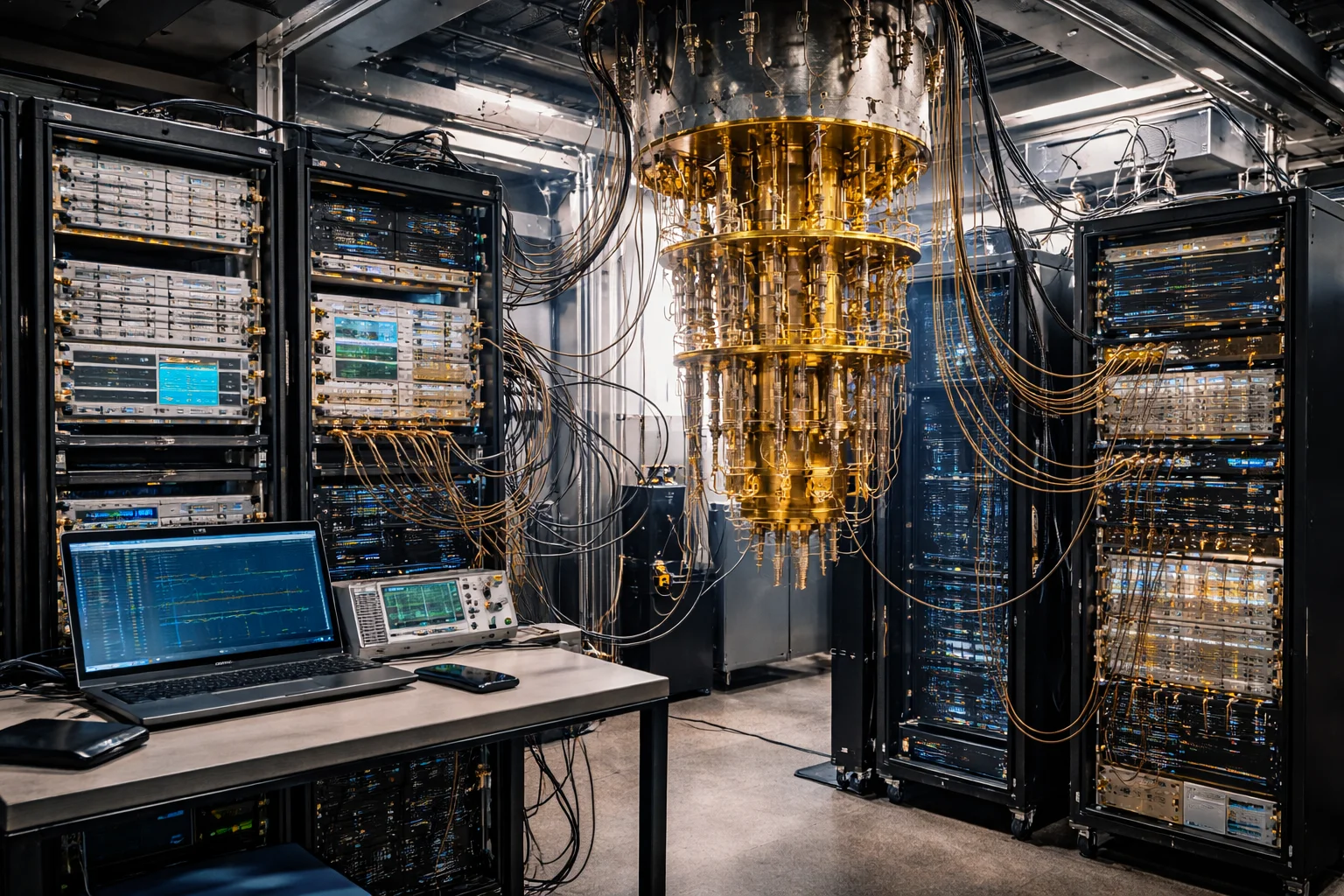
Modern quantum computers require extensive classical control infrastructure to function. Every qubit must be individually addressed with precisely timed microwave pulses, laser light, or electrical signals depending on the quantum computing platform. IBM's quantum processors, for example, require separate control lines for each qubit plus additional lines for readout and error correction. A 1000-qubit system can demand thousands of individual control channels, each requiring sub-nanosecond timing precision.
The control system complexity scales non-linearly with qubit count. Each additional qubit doesn't just add one more control channel—it increases crosstalk management requirements, calibration complexity, and synchronization challenges across the entire system. Google's Sycamore processor with 70 qubits already requires room-sized classical control racks, while IBM's roadmap toward 100,000-qubit systems implies control electronics that could fill entire buildings.
Current quantum control systems typically operate in three layers: room-temperature electronics that generate and process digital signals, intermediate electronics that provide filtering and amplification, and ultra-low-temperature electronics housed in dilution refrigerators alongside the quantum processor. This distributed architecture creates synchronization challenges that become exponentially more difficult as systems scale.
The quantum computing architecture landscape includes several competing approaches, each with distinct control requirements. Superconducting systems like those from IBM and Google require microwave control at millikelvin temperatures. Trapped-ion systems from companies like IonQ demand precise laser control and complex ion shuttling mechanisms. Neutral atom systems need sophisticated optical tweezers and magnetic field control. Despite these differences, all approaches converge on the same fundamental challenge: classical control systems that can scale efficiently while maintaining quantum-grade precision.
Key Findings
The control electronics bottleneck manifests in several critical areas that determine practical quantum system performance. Timing synchronization represents perhaps the most fundamental constraint. Quantum operations must be synchronized across all qubits within femtosecond tolerances to prevent decoherence. As systems scale, maintaining this synchronization becomes increasingly difficult due to signal propagation delays, thermal drift, and electronic noise. Companies are finding that standard electronics approaches used in classical computing simply cannot meet these requirements at scale.
Signal quality degradation emerges as another primary limitation. Quantum states are extraordinarily sensitive to electromagnetic interference, thermal fluctuations, and signal distortion. Control systems must deliver clean, stable signals across potentially thousands of channels while operating in electromagnetically noisy environments filled with pumps, compressors, and digital switching circuits. The signal-to-noise ratio requirements for quantum control often exceed those found in the most demanding classical applications by several orders of magnitude.
Calibration complexity grows exponentially with system size. Each qubit requires individual calibration of control parameters, and these parameters drift over time due to environmental changes, component aging, and quantum system evolution. A 100-qubit system might require recalibration of thousands of parameters daily, while a 1000-qubit system could demand continuous, automated calibration of tens of thousands of parameters. Current approaches that rely on manual or semi-automated calibration procedures cannot scale to large quantum systems.
Thermal management within control systems creates cascading challenges. Quantum processors operate at temperatures near absolute zero, but the control electronics generate heat that must be carefully managed. Adding more control channels increases heat load, which can destabilize quantum operations and increase cooling costs. Some companies are finding that the power consumption of control electronics exceeds the quantum processor itself by factors of 100 or more.
Cost scaling presents a significant barrier to commercial viability. High-precision control electronics are expensive, and the current approach of dedicating individual control channels to each qubit creates unsustainable cost structures. A quantum system with 10,000 qubits using current control architectures could require control electronics costing tens of millions of dollars, before considering the quantum processor itself.
Real-time feedback and error correction place additional demands on control systems. Fault-tolerant quantum computing requires continuous monitoring of quantum states and real-time correction of detected errors. This process must complete within microseconds to prevent error propagation, requiring control systems with computational capabilities rivaling high-performance computing clusters.
Implications
For enterprises evaluating quantum computing investments, the control systems challenge fundamentally alters the competitive landscape and timeline expectations. Companies that excel at precision electronics and control systems engineering may have significant advantages over those focused purely on quantum physics research. This shift favors organizations with backgrounds in aerospace, defense, telecommunications, or scientific instrumentation rather than traditional software companies.
The quantum hardware limitations imposed by control systems affect practical deployment scenarios. Near-term quantum applications will likely be constrained by the control overhead rather than quantum algorithm limitations. This reality suggests that quantum advantage will first emerge in applications that can tolerate relatively small quantum processors with exceptional control precision, rather than large systems with looser control requirements.
Investment patterns in the quantum industry are beginning to reflect this control systems priority. Venture funding is increasingly flowing toward companies developing specialized quantum control electronics, software for automated calibration, and integrated control architectures. Traditional quantum computing companies are partnering with or acquiring control systems specialists rather than building these capabilities internally.
The quantum system scaling timeline is being recalibrated based on control systems constraints. While quantum processor development continues to advance rapidly, the pace of practical system deployment is increasingly limited by control electronics development cycles. These systems require extensive testing, validation, and integration work that follows traditional engineering timelines rather than research laboratory schedules.
Supply chain considerations for quantum systems are expanding beyond exotic quantum materials to include precision electronics components, many of which have limited suppliers and long lead times. This dependency creates new vulnerabilities for quantum system manufacturers and affects their ability to scale production.
Considerations
The quantum calibration challenges create operational complexities that affect system reliability and uptime. Quantum systems require frequent recalibration that can take systems offline for extended periods. For enterprise applications, this operational overhead must be factored into availability calculations and service level agreements. Current quantum cloud services typically achieve uptime levels far below enterprise requirements, partly due to calibration overhead.
Cost-benefit analysis for quantum systems must account for the total system cost including control electronics, not just the quantum processor. This expanded cost basis changes the economic comparison between quantum and classical computing solutions. In many cases, the control system costs dominate the overall system expense, making quantum systems economically viable only for applications with very high value-per-computation ratios.
Technical expertise requirements for quantum systems are shifting from pure quantum physics toward control systems engineering and precision electronics. Organizations planning quantum computing initiatives need to evaluate their technical capabilities in these areas and adjust hiring strategies accordingly. The talent pool for quantum control systems engineering is limited and commands premium salaries.
Vendor selection criteria for quantum systems should emphasize control systems capabilities and scalability roadmaps rather than just quantum processor specifications. Organizations should evaluate vendors' control electronics expertise, calibration automation capabilities, and thermal management approaches as primary selection factors.
The quantum computing reality check for 2026 suggests that practical quantum systems will be limited more by control electronics maturity than by quantum algorithm development. This timeline mismatch affects strategic planning for organizations expecting to deploy quantum systems in the near term.
Key Takeaways
• Control systems complexity, not quantum physics, is becoming the primary bottleneck in scaling quantum computers from laboratory demonstrations to practical systems capable of solving real-world problems.
• The cost of quantum control electronics often exceeds the quantum processor itself by orders of magnitude, fundamentally changing the economic equation for quantum system deployment and affecting which applications can justify the investment.
• Precision timing, signal quality, and calibration requirements for quantum systems exceed those of most classical applications, demanding specialized engineering expertise that combines quantum physics knowledge with advanced control systems design.
• Companies with backgrounds in precision electronics, aerospace, defense, or scientific instrumentation have significant competitive advantages in quantum system development compared to purely software-focused organizations.
• Near-term quantum advantage will likely emerge in applications optimized for smaller, precisely controlled quantum systems rather than large systems with looser control requirements, affecting strategic planning for quantum application development.
• The quantum industry talent shortage is shifting from quantum physicists toward control systems engineers and precision electronics specialists, requiring organizations to adjust their hiring and partnership strategies.
• Operational complexity from continuous calibration requirements affects quantum system uptime and reliability, making current systems unsuitable for mission-critical enterprise applications that demand high availability.